Wedding Invitation Trends 2027: What's Worth It
The wedding invitation trends for 2027 are already settled. The Knot published its forecast in late September, the stationer Paperlust followed in October, and venue blogs have spent the weeks since repeating the same handful of looks. Thick cotton paper. Silver foil instead of gold. Dark card printed in white ink. Wax seals, bows, swans, and little drawings of the couple's dog.
If you are getting married in 2027, this matters right now, not next spring. Save-the-dates for a summer 2027 wedding go out this winter, and most couples pick one look and carry it from the save-the-date to the thank-you card. So the choice you make in the next few months shows up on every piece of paper your guests touch.
I write about sustainable weddings, so I read these forecasts a little differently than most. I want to know two things about every trend: what it costs, and what happens to the paper after the wedding. Some 2027 looks are lovely and light. Others turn one envelope into a small pile of things that cannot go in the recycling bin. Below are all ten major trends, the real numbers behind them, and my honest take on which ones are worth it.
Quick Navigation
- What Is Driving the 2027 Invitation Look
- Texture First: Cotton Paper and Letterpress
- Silver Foil Is Overtaking Gold
- Dark Card, White Ink, and One-Hue Suites
- Personal Motifs and Hand-Drawn Illustrations
- Coquette Bows, Swans, and Lace
- Wax Seals, Vellum, and Layered Suites
- Beach Club and Supper Club Stationery
- Arches and Shaped Cards
- QR Codes and the Paper Plus Digital Split
- Day-Of Paper Gets the Star Treatment
- What Is Fading for 2027
- What 2027 Invitation Trends Cost
- Which Trends Waste the Least Paper
- Matching a Trend to Your Venue
- When to Order for a 2027 Wedding
Key Takeaways
- A 100-guest printed suite costs about $400 to $650, but letterpress or foil can push it to $700 to $2,000 or more.
- Paperlust requires at least 50 invitations for letterpress and foil stamping, while white ink, flat foil, and digital printing start at 10.
- 58% of couples still mail paper invitations but only 41% collect paper RSVPs, so directions, hotel info, and RSVPs are moving online.
- The Knot reports searches up 280% for lace motifs, 106% for swans, and 315% for Amalfi-style Italian beach club designs.
- Wax seals and bulky layered suites can add postage surcharges and block recycling, so choosing one layer saves money and waste.
What Is Driving the 2027 Invitation Look
Three forces are shaping invitations for next year, and they pull in slightly different directions.
The first is touch. Paperlust's 2027 forecast says the big change is that "the paper itself has become the point": texture you can feel, a personal motif, and deeper color over flat minimalism. Their write-up pulls from several stationery forecasts published this summer, and they all landed in the same place. People look at screens all day. A heavy card with pressed letters feels special because so little else in the mailbox does.
The second is story. The Knot's 2027 invitation trends report puts "experiential, deeply personalized stationery" at number one. Think a flower from your hometown, a dish from your culture, or the tree where you met, drawn right onto the card. The Knot says interest in this style is up 77% from last year, based on searches on its own site, and its whole panel of wedding pros signed off on it.
The third is the phone. Zola's First Look Report found that social media drives wedding decisions for 87% of couples, and half of all couples now get wedding ideas from TikTok. That changes how invitations are designed. A suite has to look good flat-lay on a table in a photo, not just in a guest's hand.
And underneath all of it is a smaller shift in how guests reply. The 2026 State of Wedding Planning report from RSVP'd found that 58% of couples still send paper invitations, but only 41% collect RSVPs on paper. Paper is becoming the keepsake. The website is doing the paperwork.
So here is how I read the year: the card is getting nicer, and the stack of inserts inside the envelope is getting smaller. That is good news for your budget and good news for the trash can.
Texture First: Cotton Paper and Letterpress
This is the headline trend for 2027. Letterpress presses each letter into thick, soft paper, so the type sits slightly below the surface. You can feel your names with your thumb.
Paperlust calls it "the feel-first invitation" and recommends pairing it with strong type, one motif, and nothing else. That last part is the real lesson. Letterpress looks best when the design is simple, because the texture is the decoration.
Who it suits: garden weddings, historic houses, barns, vineyards, and anything described as "casual elegant."
What to know before you fall in love with it:
- It costs more. Each ink color is a separate pass through the press. A 100-guest printed suite with standard digital printing runs about $400 to $650, and letterpress or foil can push that to $700 to $2,000 or more.
- There are minimums. Paperlust requires at least 50 invitations for letterpress and foil stamping, while white ink, flat foil, and digital printing start at 10. If you are planning a small wedding, that minimum can mean paying for cards you never mail.
- One color goes a long way. A single ink on cotton paper still looks expensive. Two or three colors is where the price climbs.
My take: this is the one splurge trend I would actually spend on, with one condition. Print only the main invitation this way. Put everything else (directions, hotel info, the RSVP) online. A single beautiful card that someone keeps beats five flat inserts that go straight into the recycling.
Cotton paper also has a decent story. A lot of it is made from cotton linters, the short fibers left behind after cotton is processed for fabric, rather than from fresh-cut trees. Ask your stationer what their stock is made from. A good one will know.
Silver Foil Is Overtaking Gold
For years, gold foil was the default. If an invitation had any shine at all, it was gold. That is changing.
According to Paperlust, one summer forecast named silver overtaking gold, and a June color report placed the same shift in stationery. Silver shows up best on midnight blue, charcoal, gray, lilac, and icy blue card.
Gold is not out. It just stopped being automatic. If your palette is warm ivory, candlelight, and burgundy, gold still fits. If your palette is cool or your wedding is a winter evening, silver will look more current.
There are two ways to get foil onto paper:
- Flat foil lays a thin metallic film on parts of the design. It handles fine lines and small type well.
- Foil stamping uses a custom metal die to press the foil in, so you get shine and a pressed texture at once. It is better for bold initials than delicate script.
My take: foil is pretty, but a little goes a long way. A thin silver line around your names reads as more modern than a whole card covered in metallic. Heavy foil coverage can also make paper harder to recycle in some local programs, so a light touch is the safer choice on both counts.

Dark Card, White Ink, and One-Hue Suites
Here is a trend I did not expect to like as much as I do. Instead of printing dark ink on ivory card, 2027 suites flip it: the card itself is deep plum, midnight blue, burgundy, or chocolate brown, and the words are printed in opaque white ink.
It looks formal without trying too hard. It also photographs beautifully against linen or wood, which matters if you are planning that flat-lay photo for social media.
The color direction lines up with the bigger 2027 forecasts too. Martha Stewart's top 2027 wedding trends list regal merlot, plums, powdery blues, and moss greens as the colors to watch.
The sister trend is the one-hue suite. You pick a single color and use it at different depths across every piece. A deep navy envelope, a medium blue liner, a pale blue card, and navy ink. Every piece belongs to the same family, so it looks designed even if you made it from a template.
Who it suits:
- Fall and winter weddings
- Evening receptions
- Couples who want "formal" without white and gold
My take: dark card with white ink is a smart choice for budget couples, because it gives you a strong look with standard flat printing. No letterpress, no foil, no extra layers. Ask for a printed sample first, though. Deep colors can shift a lot between a screen and real paper.

Personal Motifs and Hand-Drawn Illustrations
The Knot ranks three related trends near the top of its list: personalized stationery, hand-drawn illustrations, and handwritten fonts.
In practice, that looks like:
- A line drawing of your venue on the front of the card
- A sketch of your pet (The Knot specifically calls out pet illustrations showing up across paper suites)
- A watercolor of the flower that grows in your hometown
- Fonts that look like real handwriting instead of formal calligraphy
The Knot describes the newest version of hand-drawn art as a little more ornate and delicate than the scribble-style doodles that were big a year or two ago. The handwriting fonts feel like a love letter rather than a formal announcement.
This is my favorite trend on the list for a simple reason. It costs almost nothing extra to print. A drawing prints the same way as a plain border. You might pay an illustrator once (or draw it yourself), and then you can reuse that same art on your save-the-date, your welcome sign, your menus, and your thank-you cards. One drawing does the work of a whole design system.
A tip from Paperlust that I agree with: ask your stationer to prepare the artwork at several sizes before you order anything. A drawing that looks great on a 5x7 card can turn to mush on a tiny place card.
If you are planning a desert or mountain wedding, a simple line drawing of the scenery can do a lot. A venue like this 40-acre Zion wedding ranch in Cedar City, Utah, with its trails, secluded lodge, and red-rock country around it, practically hands you the illustration.

Coquette Bows, Swans, and Lace
This one is pure romance. Bows, ribbons, swans, love locks, lockets, and lace patterns in soft pastels or creamy neutrals.
The numbers here are the biggest jumps in The Knot's whole report. Searches for lace motifs on The Knot are up 280% this year, and swans are up 106%. You will also hear this look called "balletcore."
It ties into a bigger lace moment in bridal fashion. WWD's coverage of New York Bridal Fashion Week Fall 2027 called allover lace the biggest trend of the season. If your dress has lace, a lace motif on the invitation is an easy way to tie the paper to the day.
My take: keep it printed. A bow drawn on the card is lovely and recyclable. A real satin ribbon tied around every invitation adds cost, adds time (someone has to tie 80 bows), and turns a recyclable card into mixed material. If you want real ribbon, use it on the handful of keepsake invitations for grandparents and close family, not the whole guest list.
Wax Seals, Vellum, and Layered Suites
Wax seals made The Knot's top ten for 2027, and vellum wraps and envelope liners show up across almost every forecast. Together, they turn a flat card into something that unfolds.
Wax seals come in two forms. Real wax, pressed with a custom stamp, or wax-look stickers. The Knot points out that stickers give you the look with a slimmer profile that mails more easily.
Vellum is the see-through layer that sits over the card. Paperlust quotes one stationer who says that mixing a few paper textures, a fold, or one hidden detail can feel considered without driving the cost up much.
Here is what the pretty photos leave out:
- Lumpy envelopes cost more to mail. A raised seal or a bulky layered suite may not go through the post office's machines, which can mean a surcharge on every envelope. Take one fully assembled invitation to the post office and have it weighed and checked before you buy stamps for the whole batch.
- Wax does not recycle. It has to be peeled off before the card goes in the bin, and most guests will not bother.
- Ask what the vellum is made of. Some translucent layers are paper and some are plastic film. Only the paper kind belongs in paper recycling.
My take: pick one. A wax seal OR a vellum wrap OR a printed liner. Paperlust gives the same advice for budget reasons: one hidden layer instead of several moving pieces. I would add that one layer is also one fewer thing to throw away.
Beach Club and Supper Club Stationery
This is the most fun trend on the list. The Knot calls it "hospitality-influenced design": invitations that borrow from the branding of boutique hotels, cocktail bars, and old-school supper clubs. Think cabana stripes, retro pool club logos, and sharp, playful fonts.
The Knot says its search data shows a 315% jump in Italian beach club looks inspired by the Amalfi Coast. The broader 2027 trend coverage keeps naming beach clubs as a whole wedding theme, not just a paper style.
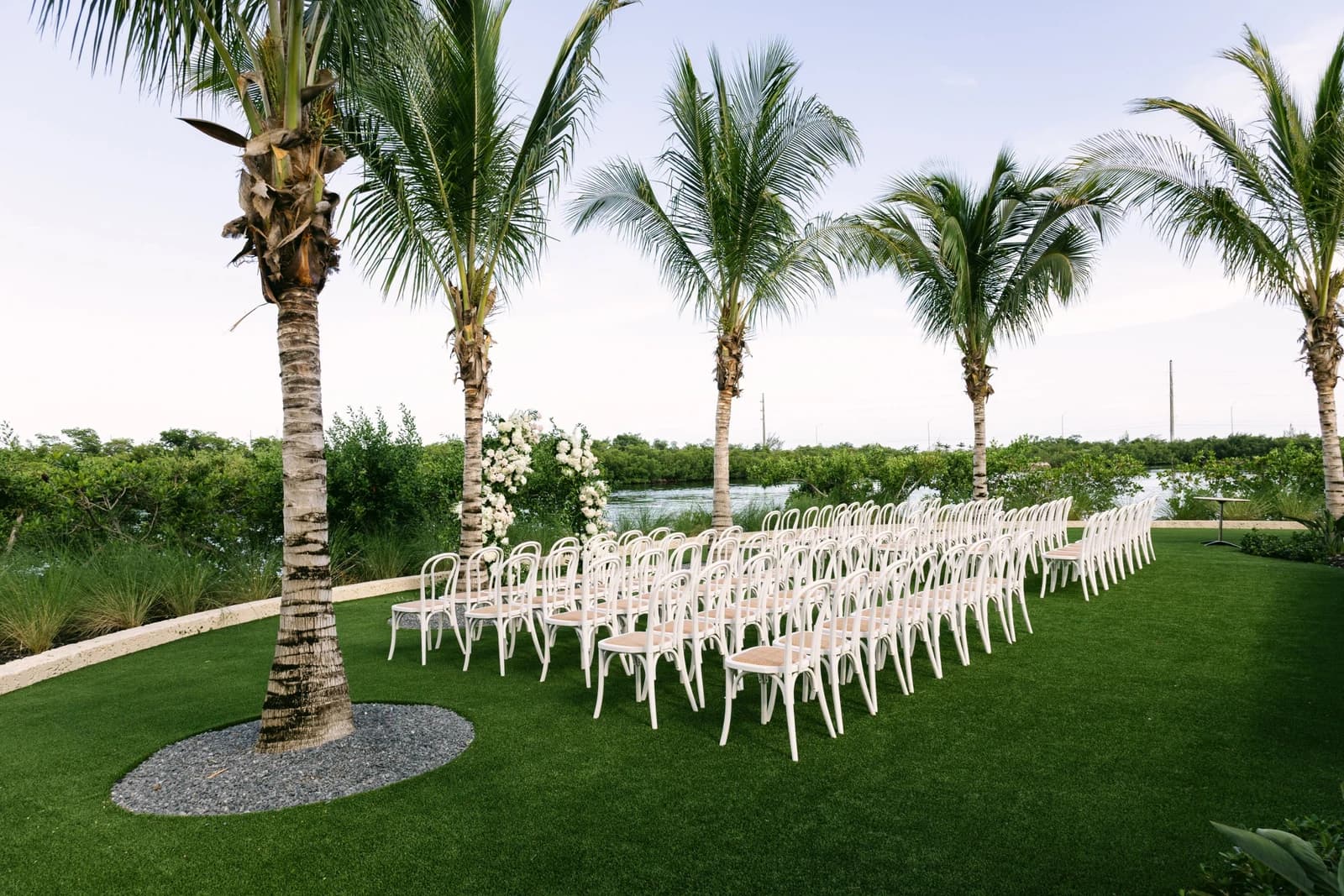
This look works best when the venue backs it up. A waterfront property with a pool, palm trees, and space for a big crowd makes cabana stripes feel earned. This Florida Keys waterfront wedding estate in Key West, with four villas on the water plus 22 more villas nearby, is exactly the kind of place where a striped, resort-style invitation sets the right tone before anyone books a flight.

My take: this trend is cheap to do well. Stripes and a bold font print fine on standard paper. You do not need foil or letterpress to make it work. It also pairs naturally with whimsical wording, another trend on The Knot's list, where the invite reads more like "Come party with us" than "request the honour of your presence."

Arches and Shaped Cards
Invitations are not all rectangles anymore. Arched tops, scalloped edges, flower shapes, and small cutouts (stars, circles) are showing up all over 2027 suites. The Ainsworth House venue blog, writing in October, listed statement shapes and layered stationery among the styles couples are choosing right now.
The best advice I found on this came from a forecast Paperlust cites: a shape needs a reason. A leaf-like curve for a botanical suite. An arch that echoes a window at your venue. A random scallop for no reason looks like a template.
Two practical checks before you order:
- Will it fit a standard envelope? Custom envelopes add cost.
- How will it mail? Square and odd-shaped envelopes can trigger the same post office surcharge as lumpy ones.
My take: a die-cut arch is a nice touch, but it creates paper scraps at the print shop. That is not a reason to skip it. It is a reason to use it on the invitation only, not on every single insert.
QR Codes and the Paper Plus Digital Split
This is the trend that will save you the most money and the most paper, and it barely looks like a trend at all.
The idea is simple. The paper invitation carries the fixed facts and the feeling: your names, the date, the city, the venue, and the time. A QR code or wedding website carries everything that can change: RSVP forms, meal choices, hotel blocks, shuttle times, and updates.
The numbers show how far this has gone. A breakdown from InviteDrop found that about 41% of 2026 couples sent paper only, 32% mixed paper and digital, and 27% went fully digital. Five years earlier, by the same count, paper-only was 71%.
The design worry is that a QR code looks stuck on. Paperlust's fix: put it on the back of the card or on a small details card, frame it with a thin line, or tuck it beside the return address. Ainsworth House suggests simply including a QR code for RSVPs "instead of separate response cards."
That last part is the big win. A traditional RSVP card needs its own card, its own envelope, and its own stamp. Drop it, and you cut a whole layer of paper and postage from every invitation. If you want help with what to say on the card itself, our guide to modern wedding invitation wording covers how to point guests to the website without sounding like a tech company.
My take: do this no matter which visual trend you pick. It is the closest thing to a free upgrade on this list.
Day-Of Paper Gets the Star Treatment
The Knot also flags something it calls "impactful supplementary stationery." Menus, table numbers, escort cards, ceremony programs, and thank-you notes are getting as much design attention as the invitation itself.
Examples from their report:
- Pop-up menus with 3D food illustrations
- Place cards with a short personal note to each guest
- Ceremony programs printed on hand fans
I like the direction, because day-of paper is where a lot of waste hides. A program that doubles as a fan actually gets used, especially at an outdoor summer ceremony. A place card with a personal note gets taken home. A generic printed program with the order of service mostly gets left on the chair.
The rule I give couples: every piece of paper at your wedding should have a job. If it does not help a guest find a seat, cool off, read the menu, or take home a memory, it can probably be a sign instead of 100 copies. One large welcome sign or menu board replaces a stack of individual cards.
What Is Fading for 2027
Paperlust has a useful list of what is stepping back. None of these are wrong, but they will read as "a couple of years ago":
- Plain minimalism with no texture. Minimal is still fine, but the 2027 version adds one layer, like cotton paper or a vellum wrap.
- Gold by default. Gold stays, but as a choice, not an automatic setting.
- Foil on smooth, flat card. It now looks unfinished unless the paper has some texture.
- Symmetrical floral borders. These are giving way to hand-painted flowers and looser frames.
- Blush and sage. The pairing is giving way to plum, mocha, olive, midnight blue, and layered pastels.
If you already bought a blush-and-sage template, do not panic. Paperlust's own advice is to keep the simple layout and add one deep tone or one softer paper. That updates it without starting over.

What 2027 Invitation Trends Cost
Here are the real numbers to plan with.
The Knot's cost data puts the average spend on wedding invitations at $220, and a full stationery suite at $510 once you add save-the-dates and day-of paper. That average includes a lot of couples using online templates. Hiring a professional stationer for a fully custom suite changes the picture: The Knot's same guide puts custom invitations for about 100 guests at $4,000 to $7,000, with semi-custom typically under $2,000.
Here is how the 2027 trends roughly sort by cost, based on how they are printed:
| Trend | How it is printed | Cost level |
|---|---|---|
| Hand-drawn illustration | Standard digital printing | Low (artwork is a one-time cost) |
| Handwritten fonts | Standard digital printing | Low |
| Beach club stripes | Standard digital printing | Low |
| QR code RSVP | Printed on main card | Saves money |
| Dark card with white ink | White ink on colored stock | Low to medium |
| One-hue suite | Colored stock and matching envelopes | Medium |
| Wax seal stickers | Added by hand | Medium |
| Real wax seals and vellum | Added by hand, may raise postage | Medium to high |
| Arches and die-cut shapes | Custom die cut | Medium to high |
| Silver foil | Flat foil or foil stamp | Medium to high |
| Cotton paper and letterpress | Letterpress, 50-piece minimum at many printers | High |
For context, a 100-guest printed suite with standard printing runs about $400 to $650, and letterpress or foil pushes it to $700 to $2,000 or more, according to Greenvelope's pricing breakdown.
Remember that invitations go to households, not people. A 100-guest list usually means somewhere around 60 to 70 invitations, which makes the expensive trends a little easier to afford than they first look. Before you lock in a stationery number, drop it into the WedStay wedding budget planner next to your other costs. Zola says the average wedding still costs about $36,000, so even a $1,500 letterpress suite is a small slice. The danger is not one big splurge. It is adding five medium ones.
Which Trends Waste the Least Paper
Here is the part I care about most. Ranked from lightest to heaviest footprint:
Lightest
- QR code instead of RSVP cards. Cuts a card, an envelope, and a stamp per household.
- Hand-drawn illustration and handwritten fonts. No extra materials at all. The art is the design.
- Dark card with white ink. One sheet, one pass through the printer.
Middle
- One-hue suites. Colored paper is fine, but matching liners add a piece.
- Cotton paper letterpress. Heavier paper, but often made from cotton leftovers, and the card tends to get kept rather than tossed.
- Beach club and supper club designs. Low impact on their own; it depends on how many inserts you add.
Heaviest
- Die-cut shapes. Scraps at the print shop and sometimes custom envelopes.
- Heavy foil. Can complicate recycling.
- Real ribbon, real wax, and plastic vellum. Mixed materials that cannot go in the paper bin together.
Try this before you order anything: lay out every piece in one sample suite and count them. A traditional set can include an outer envelope, an inner envelope, the invitation, an RSVP card, a stamped RSVP envelope, a details card, and a liner. That is up to seven pieces for one household. This is why I push the QR code so hard. The biggest cut is not a greener paper. It is mailing fewer pieces.
If you want to go further, look at recycled paper or plantable seed paper for the main card. Ainsworth House lists both, along with digital RSVPs, among the sustainable invitation options couples are choosing this year.
Matching a Trend to Your Venue
The easiest way to choose is to start with where you are getting married. Your venue already has a mood. The invitation should introduce it.
Paperlust suggests one headline trend plus one supporting trend, matched to venue, season, and formality. Here is how I would apply that:
Formal estate or black-tie evening: silver foil on midnight blue card, plus a printed monogram. A property like this lakeside estate in Morris, Illinois, with tiered pools, a grand fountain, and several terraces and verandas, calls for something polished. A crest or monogram from the invitation can repeat on the welcome sign and the bar menu.
Fall wedding by the water: cotton paper letterpress in a deep color, plus a hand-drawn line of the shoreline. This riverside retreat in New York's Finger Lakes, with its waterfront setting plus a game room and theater for the evening, fits a warm, cozy suite in burgundy or olive.

Beach or tropical destination: beach club stripes or a one-hue blue suite, with a QR code for travel details. Destination guests need more information than local ones (flights, transfers, room blocks), and none of that belongs on the card. The Key West estate above is a natural fit.
Desert, mountain, or ranch: hand-drawn scenery art in a handwritten font, with a single wax seal sticker. The Zion ranch fits here.
Small wedding of 30 or fewer: be careful with letterpress minimums. If your printer requires 50 pieces, you will pay for 20 cards you never use. Digital printing on cotton paper with one vellum wrap gives you a similar feel without the waste.
Once you have a look, keep it consistent. The same color, the same drawing, and the same font on every piece is what makes a cheap suite look custom.
When to Order for a 2027 Wedding
Trends do not matter if the paper arrives late. Here is the general order of things:
- Save-the-dates: usually six to eight months out for a local wedding, and earlier for destination weddings. For a June 2027 wedding, that means mailing around December 2026 or January 2027.
- Invitations: The Knot's guidance is to mail invitations six to eight weeks before the wedding, with more lead time for destination weddings.
- Proofs: build in time for at least one round. Paperlust, for example, sends a free digital proof one to two business days after an order, and nothing prints until you approve it.
- Postage check: weigh one fully assembled invitation at the post office before you buy stamps. This matters most for wax seals, layered suites, and odd shapes.
Our wedding invitation timeline guide walks through every mailing date in detail, and the DIY wedding checklist can help you slot stationery tasks in with everything else.
One last thought. The 2027 forecasts all point toward paper that feels personal and is made to be kept. I think that is the right direction. Pick one look you love, print the main card well, move the paperwork online, and let your guests hold onto something worth keeping.
Free Tools to Plan Your Budget
Take the guesswork out of wedding finances with tools built on real pricing data and trusted by thousands of couples.
🎯 Start PlanningWedding Budget Planner, AI-powered allocations based on your city, guest count, and style. Real-time tracking, cloud sync, and export, free forever.Wedding Venue Cost Calculator, Compare all-inclusive estate pricing vs. traditional venues. See what a wedding costs in your region with real data.Browse Vetted Vendors, 500+ vetted professionals across 11 categories. Filter by location, compare portfolios, connect directly, no fees.Get the Free WedStay App, browse venues, plan, and book on the go.
Frequently Asked Questions
When should save-the-dates and invitations go out for a 2027 wedding?
For a summer 2027 wedding, save-the-dates should go out this winter, so it's worth picking your 2027 look now. A common rule is to send save-the-dates six to eight months ahead, or closer to a year for destination weddings. Formal invitations usually go out about six to eight weeks before the date. Leave time before that for design, proofs and printed samples, especially with letterpress, foil or dark card printed in white ink, because colors can shift between the screen and real paper. Set your RSVP deadline three to four weeks before the wedding so your caterer gets final numbers in time.
Can I letterpress just the main invitation and print the rest digitally?
Yes, and it's one of the easiest ways to get the 2027 texture look without paying for it on every piece. A 100-guest suite with standard digital printing runs about $400 to $650. Letterpress or foil across the whole suite can push that to $700 to $2,000 or more. Put your money into one pressed card and keep the inserts flat, or move directions, hotel info and RSVPs to your wedding website. Check minimums first. Paperlust requires at least 50 pieces for letterpress and foil stamping, so a very small wedding may end up paying for cards it never mails.
Which parts of a wedding invitation can go in the recycling bin?
Plain paper and card are generally recyclable, including most cotton stock and cards printed with flat or white ink. The add-ons cause the trouble. Real wax seals have to be peeled off first. Satin ribbon turns a card into mixed material. Some vellum wraps are plastic film rather than paper. Heavy foil coverage can also be rejected by some local programs. Rules vary by city, so check your local recycling guidelines. For a low-waste suite, choose one printed detail instead of physical layers, and ask your stationer what each piece is made from.
Is it okay to send paper invitations but collect RSVPs online?
Yes, and most guests now expect it. The 2026 State of Wedding Planning report from RSVP'd found that 58% of couples still mail paper invitations, but only 41% collect RSVPs on paper. Print your wedding website address or a QR code on the invitation, along with a clear reply-by date. Some guests, like grandparents, may not be comfortable replying online. For them, offer a phone number or set aside a few printed reply cards. The invitation stays a keepsake and nobody gets left out.
How do I turn my own drawing into a wedding invitation illustration?
Draw in dark ink on plain white paper, then scan it at high resolution instead of photographing it, so the lines stay crisp. Many stationers can turn a scan into vector art, which resizes cleanly from a 5x7 invitation down to a place card. As Paperlust suggests, ask for the artwork at several sizes before you order, because fine detail can blur when it's shrunk. Simple line drawings work best, whether it's your dog, your hometown flower or the red-rock country around a Cedar City, Utah ranch. You can then reuse the same drawing on menus, signs and thank-you cards.
Do wax seals and layered invitations need extra postage?
Often, yes. In the US, envelopes that are lumpy, rigid, unusually thick or square can count as nonmachinable, which adds a surcharge to every envelope on top of normal postage. A raised wax seal or a bulky suite with vellum and liners often triggers it. Put together one complete invitation, take it to the post office, and have it weighed and checked before you buy stamps for the whole batch. Wax-look stickers, which The Knot notes are slimmer, or a single printed liner can keep the envelope flat. You can also ask the post office to hand-cancel the envelopes so sorting machines don't crack the seals.
Sources
1. You've Got Mail: Top Wedding Invitation Trends for 2027 · theknot.com
2. 2027 Wedding Invitation Trends: 10 Styles and Methods · paperlust.co
3. 2026 Wedding Trends: Zola's First Look Report · zola.com
4. The 2026 State of Wedding Planning · rsvpd.ai
5. The Average Wedding Invitation Cost, According to Data · theknot.com
6. Do People Still Send Paper Wedding Invitations? · invitedrop.com