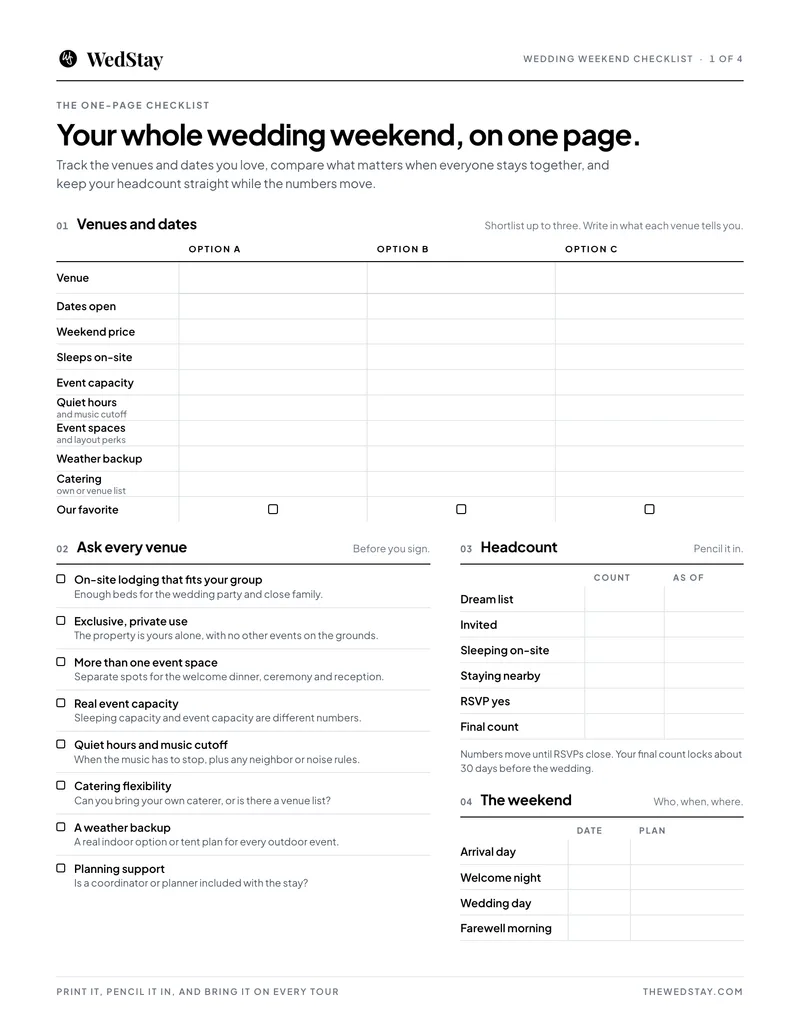
Wedding Stationery Checklist 2026: Every Piece

Six weeks before my wedding, I found out we had no escort cards. Not "the escort cards were late." We had none. They were never on any list, because my list said "invitations" and "signs" and I had assumed, like a fool, that everything else lived somewhere inside those two words. So this is the wedding stationery checklist I wish I'd had: every single piece of paper a 2026 wedding can involve, what each one costs, which ones you can skip, and how many to order.
Paper is weird. It feels small next to the venue and the caterer, and then it turns out to touch every stage of the whole thing. Save the dates go out a year early. Invitations set the tone. Then on the day itself, there's a whole second wave of paper that most couples forget to budget for, the menus and place cards and the sign that tells Uncle Ray where the bar is.
Here's the full map, organized the way I'd organize a product launch: what ships when, what it costs, and who owns it.
Quick Navigation
- What Belongs on a Wedding Stationery Checklist
- Pre-Wedding Paper From Save the Dates to RSVPs
- Day-Of Wedding Stationery Guests Actually Touch
- Wedding Weekend Paper for Multi-Day Celebrations
- What Wedding Stationery Costs in 2026
- 2026 Stationery Trends Worth Copying
- What to DIY and What to Hire Out
- A Stationery Timeline That Works Backward
- How Many of Each Piece to Order
- Stationery Mistakes I Would Undo
Key Takeaways
- Couples spend an average of $510 on a full stationery suite, but custom invitations from a professional stationer run $4,000 to $7,000 for about 100 guests.
- Budget 4 to 6% of the total wedding cost for stationery, which works out to about $1,500 to $2,300 on a $38,000 wedding.
- Postage is the most common surprise cost, since square envelopes, thick suites and wax seals can trigger nonmachinable surcharges.
- A QR code or wedding website link in place of RSVP cards saves reply envelopes and postage, with paper cards kept only for older guests.
- One large seating chart sign usually costs less than 120 individual escort cards, and one menu per table costs about a tenth of one per place setting.
What Belongs on a Wedding Stationery Checklist
Stationery people talk about "the suite," which sounds fancy but just means the matching set. In practice, wedding paper splits into three buckets, and once you see it this way the planning gets a lot less mushy.
Bucket 1: Pre-wedding paper. Everything that arrives in a mailbox (or an inbox) before the day.
- Save the dates
- Invitations
- RSVP cards (or an RSVP link on a details card)
- Details or information cards (hotel, website, dress code)
- Envelopes, inner envelopes, liners, and postage
- Rehearsal dinner or welcome party invitations
- Bridal shower and bachelor or bachelorette invites (usually someone else's job, but it's still paper)
Bucket 2: Day-of paper. The stuff guests pick up, read, or walk past on the wedding day.
- Welcome sign
- Ceremony programs
- Escort cards or a seating chart
- Place cards
- Table numbers or table names
- Menus
- Bar menu or signature cocktail sign
- Directional and "unplugged ceremony" signs
- Favor tags, napkin bands, and the card box label
Bucket 3: After-wedding paper. The part you'll want to skip and shouldn't.
- Thank you cards
- Wedding announcements (for people you couldn't invite, or for an elopement)
You will not need all of this. A 30-person dinner at a long table needs place cards and maybe a menu, and that's about it. A 150-guest wedding with assigned seating needs basically everything above. The point of the list is not to buy more. The point is to make the decision on purpose for each line, instead of discovering a missing piece in month eleven like I did.
My one PM rule for this whole category: every piece of paper should have a job. If you can't say what a piece does for a guest (gets them to the right place, tells them what's happening, tells them what they're eating), it's decoration. Decoration is allowed. Just budget it as decoration.
Pre-Wedding Paper From Save the Dates to RSVPs
This bucket gets the most attention and, honestly, the most money. Here's what each piece is for and where I'd trim.
Save the Dates
These exist for one reason: so people with jobs, kids, and frequent-flier points can block the date. They matter more if you're asking anyone to travel. If your wedding is local and your guest list is mostly family who already know the date, a digital save the date is completely fine. We mailed paper ones because about a third of our guests were flying in from two different countries, and my grandmothers were not going to check an email.
According to The Knot's cost data, couples spend an average of $150 on save the dates. That number is easy to beat with a simple postcard format, which also skips the envelope.
Invitations and Enclosures
The invitation itself is the hero piece. Enclosures are the little cards that travel with it. A typical modern set is invitation, RSVP card with its own envelope, and one details card. That's enough for most weddings.
Where couples pile on cost is the extras: belly bands, vellum wraps, liners, inner envelopes, wax seals. Each one is a few cents to a couple of dollars per invite, and then you multiply by your guest count and it stops being a few cents.
Here's a move I'd make again: replace the RSVP card with a QR code or a short link to your wedding website. You save the reply envelope, the reply postage, and the hours of decoding your cousin's handwriting. If you have older guests, keep a paper RSVP option for just those households. You can order a short run of reply cards for them and send everyone else to the link.
Postage (the Line Item That Ambushes Everyone)
Postage gets its own section because it is the single most common budget surprise in this whole category. Square envelopes, thick suites with multiple cards, and wax seals often push an invitation past standard letter postage and into a nonmachinable surcharge. Take one fully assembled invitation, with everything inside it, to the post office and have it weighed before you buy stamps for the whole batch. It takes ten minutes and it can save you from 100 envelopes coming back.
Day-Of Wedding Stationery Guests Actually Touch
This is the bucket that bit me, and it's the one I want you to plan early. Day-of paper is where guests actually interact with your stationery. Nobody keeps your RSVP card. Everyone reads the menu.

Welcome Sign
One sign at the entrance with your names and the date. It's the first thing guests see and the thing that ends up in the most photos. If you only splurge on one piece of day-of paper, this is a good candidate.
Ceremony Programs
Programs are optional, and plenty of couples skip them now. I'd keep them if your ceremony has parts guests won't recognize. Ours did. We blended a Korean tea ceremony, a Japanese san-san-kudo sake ritual, and American vows, and a short program explaining each part meant our friends knew what they were watching instead of whispering "what's happening?" through the most emotional ten minutes of my life. If your ceremony is a standard 20 minutes with no surprises, a single sign with the order of events does the same job.
Escort Cards vs. Seating Chart
Escort cards tell guests which table they're at. Place cards tell them which seat. You need one of these if you're assigning tables, and you need both only if you're assigning specific seats (common for plated dinners where the caterer needs to know who ordered the fish).
A big seating chart sign is usually cheaper than 120 individual escort cards, and it's one item to set up instead of 120. The tradeoff is the traffic jam: if 150 people all crowd one sign at once, cocktail hour turns into a line. Alphabetize by last name and make the text bigger than you think it needs to be.
Table Numbers and Menus
Table numbers are non-negotiable if you have a seating chart. Menus are a nice touch, and they're also a practical one: guests with allergies read them carefully. The Knot's 2027 invitation trends report calls out menus specifically as a spot where couples are getting creative, from pop-up menus to illustrated dishes, and personalized place cards with a short note to each guest.
One menu per table, standing in the middle, is perfectly fine. One per place setting looks lovely and costs roughly ten times as much.
Bar and Directional Signs
A bar menu sign stops the bartender from explaining your signature cocktail 200 times. Directional signs matter more than you'd guess at private homes and estates, where guests have no idea where the bathroom, the parking, or the ceremony spot is. At a venue like this historic Italian castle in Siena that sleeps 22, a few small signs pointing people from the courtyard to the dinner space would save a lot of wandering.
The Little Stuff
Favor tags, napkin bands, the "cards" sign on the gift table, a "reserved" card for the first row. Tiny. Easy to forget. Put them on the list anyway, because the night before the wedding is a terrible time to be hand-lettering "Reserved" on an index card. (Ask me how I know.)
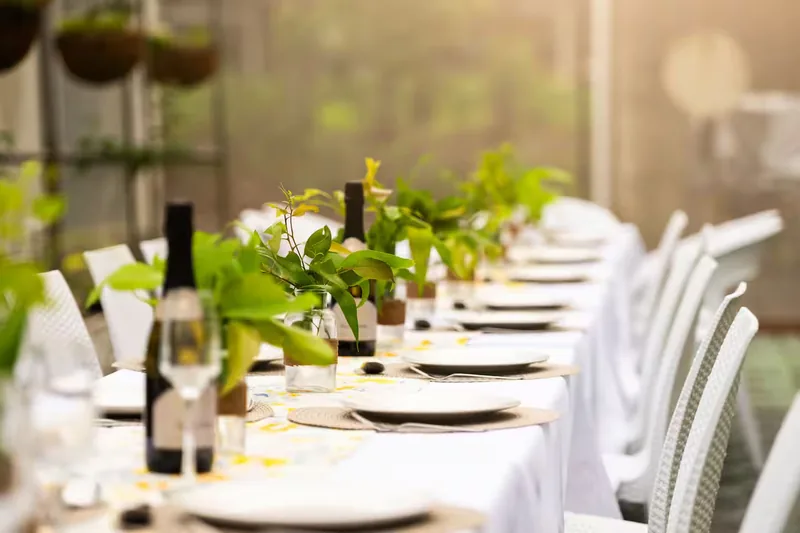
Wedding Weekend Paper for Multi-Day Celebrations
Weddings keep stretching into full weekends. A recent roundup from Yahoo Creators describes Friday welcome dinners, Saturday weddings, and Sunday brunches turning celebrations into full weekends, especially when guests are already traveling. More events means more paper, and this is where a good system pays for itself.
If you're hosting a weekend, here's what gets added:
- Weekend itinerary card. One card, tucked into the invitation or the welcome bag, listing every event, time, location, and dress code. This is the most useful piece of paper in the whole weekend. Guests will photograph it and refer to it constantly.
- Welcome bag note. A short note with Wi-Fi, a map, and the itinerary again (people lose the first one).
- Rehearsal or welcome dinner invite. Can be a digital invite to keep costs down.
- Brunch sign or menu. Simple is fine. Everyone is tired.

When your guests are all staying in one place, the paper gets easier. You can put the itinerary in every bedroom instead of mailing it. At this historic 9-bedroom Ocean City home one block from the beach, which sleeps 20, a little card on each nightstand would do the work of a dozen group texts.
The welcome bag card also has a fun data point behind it. After my wedding I surveyed all 127 guests, and the number one thing they remembered wasn't the food or the venue. It was the personalized welcome bags. The card inside each one was a $0.40 print. That might be the best return on any dollar I spent.
What Wedding Stationery Costs in 2026
The numbers come from The Knot's Real Weddings Study data, compiled in their guide to the average cost of wedding invitations:
| Item | Average spend |
|---|---|
| Save the dates | $150 |
| Invitations (including RSVP cards) | $220 |
| Day-of paper (signage, menus, etc.) | $150 |
| Full stationery suite | $510 |
Now here's the part that made me spit out my coffee. Those averages include a lot of couples using online printers and templates. Once you hire a professional stationer, the numbers change completely. The same Knot guide puts custom invitations and enclosures from a pro designer at $4,000 to $7,000 for about 100 guests, and semi-custom invitations at typically under $2,000. Day-of stationery alone runs close to $1,500 semi-custom, and $2,500 to $5,000 or more for fully custom.
A breakdown from the stationery studio Every Little Something lands in the same range, with fully custom work from a design studio generally starting between $3,000 and $7,000 for the invitation suite alone.
So the realistic range for "all our wedding paper" is something like $500 on the low end to $10,000 or more on the custom end. That's a huge spread, and the difference is almost entirely about who designs it, not how many pieces you order.
How Much Should You Budget?
A common rule of thumb, which Shine Wedding Invitations also uses, is to allocate around 4 to 6% of your total wedding budget to stationery. On a $38,000 wedding (ours was $38,247, and yes, I know the exact number), that's roughly $1,500 to $2,300.
That rule felt high to me at first. Then I added up postage, the day-of signs, and thank you cards and realized I'd landed right inside it. I'd treat 4% as a reasonable target and 6% as the ceiling unless paper is genuinely your thing.
Where the Money Actually Goes
From my own spreadsheet, the surprises weren't the invitations. They were:
- Postage. Our thick suite needed extra postage for every envelope.
- Signs. Foam board and acrylic signs add up fast, and big ones cost the most.
- Rush fees. Remember the missing escort cards? Rush printing.
- Reprints. One typo on the menus. One.
Build a 10% buffer into the stationery line. You will use it.

2026 Stationery Trends Worth Copying
I'm going to be selective here, because trend lists can make you feel like you need all of it. You don't. These are the ones I think are worth your money in 2026, backed by The Knot's search data from their 2027 invitation trends report, which tracks what couples planning right now are looking for.
Personal, Story-Driven Details
This is the big one. The Knot says experiential, deeply personalized stationery is up 77% since last year in their on-site search data. Think: a flower from your hometown on the invite, a dish from your culture on the menu, an illustration of the place you met.
I love this trend because it costs almost nothing extra if you plan it early. We put a tiny illustration of a persimmon (my grandmother's tree) on our menus. Guests asked about it all night. It was the cheapest conversation starter in history.
A Wedding "Brand" That Runs Through Everything
The TODAY.com preview of The Knot's 2027 trends notes that many couples are creating a uniform brand for their wedding, from the invitation to the wedding website. The Knot's stationery report backs that up with "branded details," like a wedding crest or monogram that appears on every piece.
This one is extremely PM-coded and I'm a fan. One crest, one color palette, two fonts. Use them on the invite, the website, the signs, the napkins, the thank you cards. It makes even budget printing look intentional. If you want to make your own, start with one simple shape and your initials, and keep it legible at the size of a napkin corner.
Lace, Bows, and Soft Romantic Motifs
According to The Knot, lace motifs are up 280% in their search data, and swans are up 106%. These are easy to add to existing templates without going fully custom.
Beach Club and Hotel-Style Design
The Knot's report also flags hospitality-inspired design, with Italian beach club aesthetics up 315%. Cabana stripes, retro fonts, cocktail-menu energy. This works best when it matches your setting. At a beach weekend house, it's perfect. At a mountain cabin, it's confusing.
Silver Is Having a Moment
The same TODAY.com preview says gold isn't going anywhere, but silver is trending more, especially in stationery. Silver foil reads cooler and more modern. It also pairs nicely with black and white suites if you want something crisp.

Trends I'd Skip
Two opinions, take them or leave them. First, anything that makes the invitation hard to read (super-light ink on vellum, scripts so loopy your grandparents need a magnifying glass). Second, pricey multi-layer suites with five enclosures when one QR code would do. I A/B tested two invitation designs with 20 friends before ordering. The "simpler" one got three times as many compliments as the elaborate letterpress version that cost twice as much. People like clarity more than they like texture.
What to DIY and What to Hire Out
DIY stationery can save real money, or it can eat four weekends and your sanity. Here's how I'd split it, sorted by risk.
Great to DIY:
- Favor tags and napkin bands (low stakes, nobody inspects them)
- Table numbers (print at home on heavy cardstock, slip into frames)
- Place cards, if you have decent handwriting or a good printer
- The weekend itinerary card
- Simple signs printed at a local print shop from your own design file
Use templates from an online printer:
- Save the dates
- Invitations and RSVP cards, if you want that polished look without custom design fees
- Thank you cards
Worth paying a pro for (if anything):
- The invitation, if paper genuinely matters to you
- Your crest or monogram, so everything else can be DIY around it
- Large signs, like the welcome sign and seating chart, because big printing errors are expensive and very visible
The highest-use split I've seen: pay someone once for the design system (a crest, a palette, a font pairing), then DIY or template everything else using those pieces. You get the "branded details" look for a fraction of fully custom pricing.
If you're renting a private estate, DIY gets easier because you usually get access to the space before the event. At the secluded Texas Hill Country estate in Dripping Springs that sleeps 18, you and your wedding party could set out place cards and signs the day before, instead of cramming it into a two-hour venue window.

A Stationery Timeline That Works Backward
Here's my timeline, built backward from the wedding date the way I'd build any launch plan. Adjust the front end if you're hosting a destination wedding, which needs more lead time for travel.
| When | Task |
|---|---|
| 12 months out | Pick your palette, fonts, and any crest or monogram |
| 8 to 10 months out | Order and send save the dates (sooner for travel weddings) |
| 5 to 6 months out | Finalize invitation design and enclosures |
| 3 to 4 months out | Order invitations, weigh one at the post office, buy postage |
| 8 to 10 weeks out | Mail invitations |
| 6 weeks out | Order day-of paper: programs, menus, signs, table numbers |
| 4 weeks out | RSVP deadline |
| 2 to 3 weeks out | Final seating chart, then print escort and place cards |
| 1 week out | Proof everything one last time, assemble, label boxes |
| Within 3 months after | Send thank you cards |
The step people skip is the six-week order of day-of paper. It sits in a weird gap: too late to bundle with invitations, too early to feel urgent. Put it on your calendar now. That's literally the step I missed.
Escort cards and place cards come last on purpose. You can't print them until RSVPs are in and the seating chart is final, and seating charts always change in the last two weeks. (Someone always breaks up. Someone always adds a plus-one.)
How Many of Each Piece to Order
Counting is where stationery orders go wrong, because some pieces are per household and some are per guest. Here's the cheat sheet I used.
| Piece | Count by |
|---|---|
| Save the dates | Household |
| Invitations | Household |
| RSVP and details cards | Household |
| Programs | About one per couple or household attending, plus extras |
| Escort cards | Guest (or household, if you seat families together) |
| Place cards | Guest |
| Menus | Guest, or one per table |
| Table numbers | Table |
| Thank you cards | Gift or household, plus extras |
Order extras. I ordered about 15 extra invitations beyond our household count, and I used almost all of them: a few for keepsakes, a few for the photographer's flat lay, several for addressing mistakes, and two for late additions to the guest list. Reprinting a small batch later costs far more per piece than adding them to the original order.
For 127 guests, we had roughly 70 households. That meant about 85 invitations, 127 place cards, 14 table numbers, and a lot of very specific spreadsheet tabs.

Small weddings get to skip a lot of this math. At an estate like this editorial Marietta, Georgia wedding estate with statement architecture that sleeps 10, a micro wedding might need 25 invitations, one long-table menu, and handwritten place cards. That's a weekend project, not a budget line.
Stationery Mistakes I Would Undo
Here's what I wish someone told me before I started, in order of how much each one cost me.
1. Treating "day-of paper" as one task. It's ten tasks. Write each one down separately, with an owner and a deadline. My escort cards fell through the gap because nobody owned them.
2. Not proofing with fresh eyes. I proofed our menus five times. My sister found the typo in under a minute. Have someone who has never seen the design read every piece out loud, including names and dates.
3. Ordering signs too small. A seating chart that looks huge on your laptop looks like a postage stamp on an easel across a room. Print a test page at full size, tape it to a wall, and stand 10 feet back.
4. Forgetting the "how will guests read this at night" test. Reception lighting is dim. Thin fonts and light ink disappear. Your menu should be readable by candlelight, because that's when people read it.
5. Skipping a stationery box. On the day, one labeled box with every piece of paper, sorted by location (ceremony, cocktail hour, reception), plus a printed setup diagram for whoever is placing them. My coordinator thanked me for this more than anything else.
6. Putting off thank you cards. We wrote ours over three Sunday afternoons with takeout and a playlist. Do it within three months. Buy the cards with your original order so they match and you can't use "need to buy cards" as a reason to stall.
7. Paying for things no one would miss. Our inner envelopes. Gorgeous. Zero guests noticed. If I did it again, I'd cut them and put that money toward a nicer welcome sign, which showed up in about half of our photos.
The big lesson from my whole paper saga: guests remember paper that helps them or tells them something about you. The menu with a dish from your family, the itinerary that saves them from texting you, the sign with a story behind it. Spend there. Everything else is optional, and optional is a perfectly good word to say out loud to a stationer.
Free Tools to Plan Your Budget
Take the guesswork out of wedding finances with tools built on real pricing data and trusted by thousands of couples.
🎯 Start PlanningWedding Budget Planner, AI-powered allocations based on your city, guest count, and style. Real-time tracking, cloud sync, and export, free forever.Wedding Venue Cost Calculator, Compare all-inclusive estate pricing vs. traditional venues. See what a wedding costs in your region with real data.Browse Vetted Vendors, 500+ vetted professionals across 11 categories. Filter by location, compare portfolios, connect directly, no fees.Get the Free WedStay App, browse venues, plan, and book on the go.
Frequently Asked Questions
How many wedding invitations should I order for my guest count?
Count households, not guests. A married couple or a family living at one address gets one invitation, so 150 guests might only need 80 to 100 suites. Then add a small batch of extras for addressing mistakes, late additions to the guest list, and keepsakes for you and your photographer. Reprints cost far more than a few spare cards ordered up front, and a single typo on the menus is enough to force a reprint. Make the same household count for save the dates and thank you cards so all three orders match.
Can I DIY my wedding stationery to save money?
Yes, and many couples already do. The Knot's average of $510 for a full stationery suite includes a lot of couples using templates and online printers, while custom work from a professional stationer can run $4,000 to $7,000 for about 100 guests. A good split is to buy printed invitations and save the dates, then DIY the small day-of pieces like table numbers, favor tags, and the "reserved" cards. Budget your time as well as your money, because hand-assembling and addressing 100 suites takes several evenings. Finish anything handmade weeks ahead, not the night before.
What information goes on a wedding details card?
A details card holds the practical information that would clutter the main invitation. Most include the wedding website URL or QR code, hotel or room block information, transportation or parking notes, and the dress code. If you're hosting a full weekend, this is a good place for a short itinerary listing the welcome dinner, ceremony, and Sunday brunch with times and locations. Keep it to one card where you can. Every extra enclosure adds printing cost and weight, and the post warns that thick suites are the most common reason invitations need extra postage.
Do I still need thank you cards if I thanked guests at the wedding?
Yes. Thanking people at the reception is lovely, but a written note is still expected for gifts, and it's the one piece of paper guests actually keep. Order thank you cards with your main suite so they match and you aren't paying for a separate rush order later. Keep a running spreadsheet of who gave what as gifts arrive, which makes writing the notes much faster. Add the cost of the cards and their postage to your stationery line from the start, because they're easy to leave out of the 4 to 6% budget.
What should I do if I realize a piece of wedding stationery is missing close to the date?
First, decide whether the piece really needs a separate printed item. Missing escort cards can become one large seating chart sign, which is usually cheaper than individual cards and only one thing to set up. Missing programs can become a single sign with the order of events. If you do need a print run, expect rush fees, especially if you are only a few weeks out. This is where the recommended 10% stationery buffer earns its keep. Go back through all three buckets, pre-wedding, day-of, and after-wedding, so nothing else surprises you.
Sources
1. The Complete Guide to Planning a Wedding · brides.com
2. The Etiquette of Having Children at Your Wedding · marthastewart.com
3. The Etiquette of Wedding Rehearsal Dinners · marthastewart.com
4. Wedding Invitation Etiquette - Is it OK to Send an Evite? · townandcountrymag.com