How to Plan an Estate Wedding Weekend in 2026

To plan an estate wedding weekend in 2026, you book one private estate for two or three nights, then build a Friday to Sunday schedule around it: welcome party Friday, ceremony and reception Saturday, farewell brunch Sunday. Everything else (vendors, rentals, sleeping arrangements, guest communication) hangs off that single booking and that single schedule.
That is the whole model. One property, one contract, one address on the invitation, and about 48 to 72 hours instead of a five hour reception block.
I have planned my own wedding and then spent the years since taking apart other people's budgets and timelines, and the estate weekend is the format where I see couples make the biggest gains and the biggest mistakes. The gains are real. So are the mistakes, and most of them happen in the boring stuff nobody posts about: load-in order, trash, who is sleeping where on Saturday night, and what time the music has to stop.
Here is the full plan, step by step, with real 2026 numbers.
Quick Navigation
- How to Plan an Estate Wedding Weekend in 2026
- What an Estate Wedding Weekend Actually Costs in 2026
- Booking the Estate: What to Confirm Before You Pay
- Who Sleeps Onsite (and Where Everyone Else Goes)
- The Friday to Sunday Timeline That Actually Works
- Coordinating Vendors Across Three Days
- Feeding People for Five Meals, Not One
- Rentals, Power, and the Boring Stuff That Breaks Weekends
- Guest Communication From Save the Date to Sunday
- Your 12-Month Estate Weekend Planning Timeline
- The Mistakes That Cost Couples the Most
Key Takeaways
- Estate weekend packages run about $8,000 to $41,000 total across WedStay's 100+ multi-day properties, covering 2 to 7 nights and 4 to 260 onsite guests.
- The honest comparison is estate rental against venue fee plus rehearsal dinner, hotel block, brunch venue, and transportation, not venue fee alone.
- Event capacity and sleeping capacity rarely match: a Mebane, North Carolina estate sleeps 16 but hosts 300, and a New Jersey estate sleeps 22 with the same 300 event cap.
- The Knot's 2026 study of 10,474 couples puts the average wedding at $34,200 with 117 guests and $292 per guest, before weekend add-ons like a $2,800 welcome dinner and $1,044 transportation.
- Roughly 18% of couples now book a two to three day wedding weekend, per Zola, with The Knot Worldwide flagging it across 54,326 couples surveyed.
How to Plan an Estate Wedding Weekend in 2026
Nine steps, in the order I would actually do them:
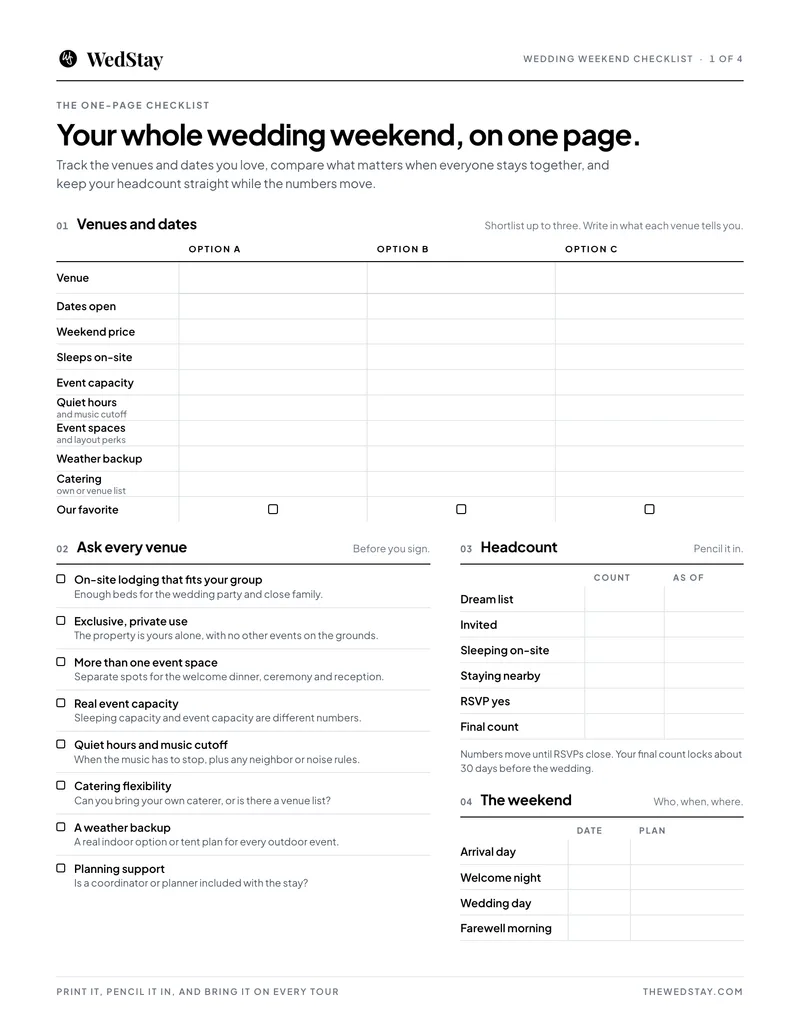
- Set your guest count and your overnight count separately. These are two different numbers and confusing them is the single most common planning error. You might have 120 people at the ceremony and 18 sleeping onsite.
- Book the estate 12 to 18 months out. Weekend dates at properties with real event capacity go first, and popular Saturdays in May, June, September, and October go earliest.
- Confirm the event rules in writing before you pay. Event capacity, music curfew, whether outside vendors are allowed, parking, insurance requirements, trash removal. All of it, in the contract.
- Hire a coordinator who has run a multi-day event. Not a day-of coordinator. A weekend coordinator.
- Lock catering next, because a weekend needs four or five meals, not one dinner.
- Build the run of show for all three days, hour by hour, before you book anything else.
- Order rentals against that run of show, including the pieces you will forget (extra trash cans, bathroom trailer, generator, lighting for the walk between spaces).
- Send guest logistics early and repeat them. Arrival window, dress codes per event, what is optional, where to park.
- Plan teardown and checkout the same way you planned setup, because Sunday morning at 10am with a hangover is not when you want to be improvising.
That is the skeleton. The rest of this post is the meat on it.
What an Estate Wedding Weekend Actually Costs in 2026
Real numbers first, because everything else is a guess without them.
The Knot's 2026 Real Weddings Study (10,474 US couples married in 2025) puts the average wedding at $34,200, with an average of 117 guests and an average cost per guest of $292. Zola's 2026 First Look Report lands a little higher at $36,000. Both numbers describe a one day wedding.
Now add the weekend pieces those averages mostly leave out:
- Rehearsal or welcome dinner: $2,800 average. Couples with more than 100 guests average $3,139. Couples with 50 or fewer average $1,630.
- Transportation: $1,044 average. Under 50 guests it drops to $583. Over 100 guests it climbs toward $1,200. Regional shuttle averages run about $965 in the Midwest, $1,000 in the South, $1,350 in the Northeast, and $1,500 in the Mid-Atlantic.
- Coordination: wedding planners average $2,100. A day-of coordinator typically runs $800 to $2,500 (about $1,600 average) and month-of coordination runs $1,500 to $4,000.
The estate itself is the number people fixate on. WedStay's multi-day wedding venues collection has 100+ properties with weekend packages ranging from about $8,000 to $41,000 total, with rentals from 2 to 7 days and onsite guest capacity between 4 and 260.
Here is the comparison that matters, and it is the one I wish someone had drawn for me. A traditional venue gives you a room and roughly five hours. An estate weekend gives you the same property for 48 to 72 hours, plus the beds. So the honest math is not "estate rental versus venue fee." It is "estate rental versus venue fee plus rehearsal dinner venue plus hotel block plus brunch venue plus the transportation between all of them."
In my experience that reframe changes the answer for maybe 60% of couples who run it. Not all of them. If your guest list is 200 people who all live in one city, a hotel is often still simpler and sometimes cheaper. Run your own version in the wedding venue cost calculator rather than trusting my gut or anyone else's.
One quick note on how estate pricing works, because it confuses people: these are totals for the minimum stay, usually two nights, sometimes three. The number you see is what the weekend costs, not a per person or per day rate.
Booking the Estate: What to Confirm Before You Pay
Okay, so this is the section where I get bossy, because a bad contract is the thing you cannot fix later.
Before any deposit leaves your account, get written answers to these:
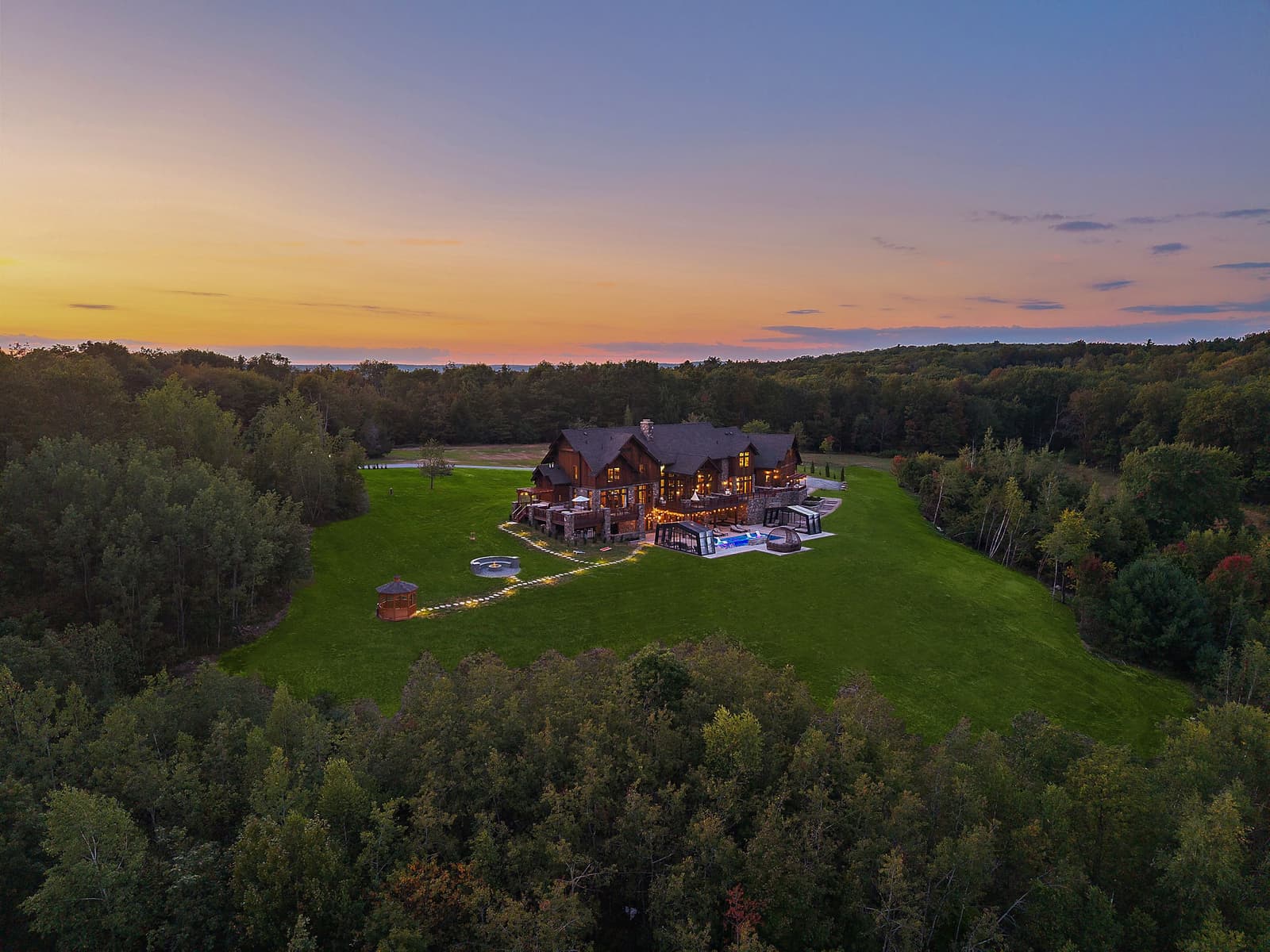
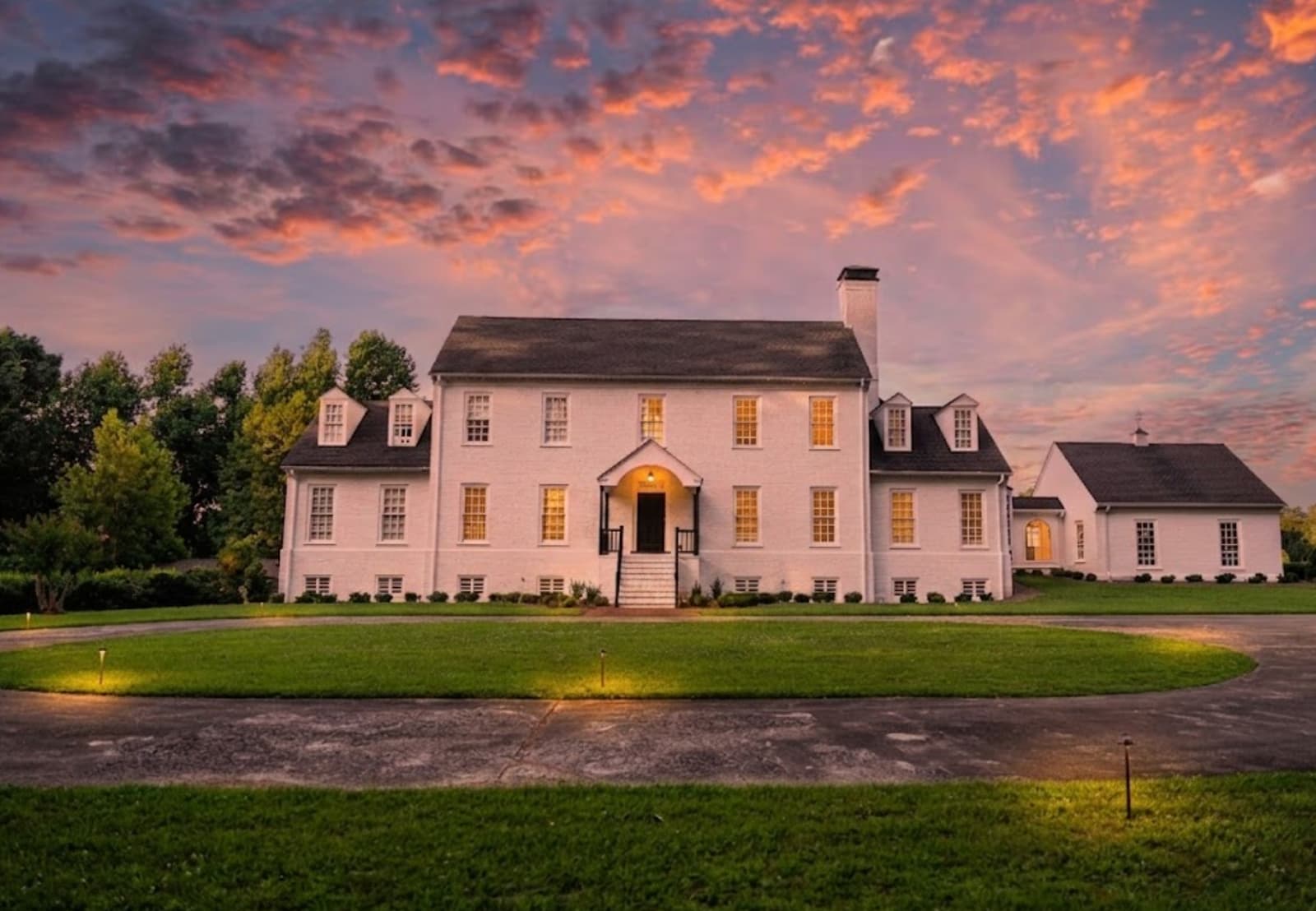
Event capacity versus sleeping capacity. They are almost never the same. This Italian-inspired estate in Mebane, North Carolina sleeps 16 across 7 bedrooms but hosts events up to 300. This 10-bedroom New Jersey estate about an hour from New York City sleeps 22 and also handles up to 300 event guests. Different properties draw that line in very different places.
Music curfew and noise rules. Ask for the exact time amplified music must stop and whether that is a house rule or a county ordinance. There is a difference. House rules sometimes bend. County ordinances do not, and a citation on your wedding night is a memorable kind of terrible.
Outside vendors. Can you bring your own caterer, or is there a required list? Required lists are not automatically bad (they know the property, which saves you real hours), but you need to know before you fall in love with a chef.
Setup and teardown windows. If your rental starts Friday at 4pm, your tent company cannot arrive Friday at 9am. I have watched that exact mismatch cost a couple an extra night's booking, added late, at full price.
Insurance. Most estates require event liability coverage, often $1M to $2M, with the owner named as additional insured. Budget $150 to $500 and buy it once you have the contract in hand, not before.
Parking and access. How many cars fit? Is the driveway steep, gravel, or narrow? Can a box truck turn around? Your florist will ask, and "I think so?" is not an answer.
Trash and checkout. Who hauls out 120 people worth of trash on Sunday? Some properties include it, some charge, some hand you a dumpster key and a prayer. Find out in month one, not on Sunday morning.
Confession time: I skipped the trash question on a weekend I helped plan in my early days and we ended up loading nine bags into a rented SUV at 8am while everyone else ate pancakes. Not a disaster. Just deeply unglamorous, and completely preventable with one email.
Who Sleeps Onsite (and Where Everyone Else Goes)
This is the question that makes couples the most anxious, and the answer is simpler than it feels.
Onsite beds go to the people who need to be onsite at 7am. That is you, the wedding party, immediate family, and anyone helping with setup. Everyone else stays nearby and drives or shuttles in.
Do guests pay for their rooms? Usually the couple covers the estate as part of the venue cost, since the beds come with the property. Some couples ask the wedding party to chip in for their rooms, which is normal and fine as long as you say so before people book flights. What you cannot do is spring it on them in month ten.
For the guests who are not sleeping onsite, book a nearby block early and give people the address, drive time, and a link in the same message. If your estate is genuinely remote, a shuttle is not a luxury, it is the thing that lets people drink at your wedding. Two runs (one at the start of the reception, one at curfew) covers most weekends. Add a mid-evening run if you have older guests or families with kids.
Real talk: the sleeping chart is also a diplomacy document. Someone will be unhappy about a bunk room. Decide the assignments yourself, write them down, post the list on the fridge when you arrive, and do not reopen the negotiation. Every hour spent relitigating bedrooms is an hour you are not spending at your own wedding.

The Friday to Sunday Timeline That Actually Works
Multi-day is not a fringe format anymore. Zola found roughly 18% of couples now opt for a full two to three day wedding weekend, and The Knot Worldwide's 2026 report (54,326 couples, ten languages) flagged three day weekend weddings as a defining trend.
Here is the shape that holds up, and I mean holds up in the sense of "people are not exhausted by Saturday at 3pm."
Friday
- 10am to 2pm: your arrival and setup. Not guest arrival. Yours.
- 2pm to 4pm: vendor load-in for anything that needs to be built (tent, dance floor, tables).
- 4pm to 6pm: guests arrive and check in. Someone who is not you should be handling this.
- 5pm: ceremony rehearsal, 45 minutes, not two hours.
- 6:30pm: welcome party. Keep it casual. Taco bar, pizza, a grill, yard games, and a bar that closes at a sane hour.
- 10pm: fire pit for whoever is still up. No program, no toasts, no schedule.
Saturday
- 8am to 10am: coffee and breakfast, self serve, nothing catered.
- 10am to 1pm: hair and makeup starts. This always takes longer than the artist says. Add 45 minutes.
- 11am to 3pm: main vendor load-in. Florals, catering, rentals, DJ. This is your busiest window and it needs a written order.
- 2pm: getting ready photos.
- 4pm or 5pm: ceremony. Ask your photographer for the exact golden hour time for your date and location, then set the ceremony 90 minutes before it.
- 5:30pm: cocktail hour while the ceremony space is flipped.
- 6:30pm: dinner.
- 8pm: dancing.
- 10pm or 11pm: music curfew, whatever the contract says.
- After: late night snack, fire pit, pool if the property has one and your insurance allows it.
Sunday
- 9am to 11am: farewell brunch. Bagels and a coffee urn count. Nobody wants a seated meal.
- 10am to 12pm: vendor teardown and pickup.
- 11am or 12pm: checkout, or a late checkout if you negotiated one.
The two hard rules I would put on a poster: nothing scheduled before 9am on any day, and at least one three hour block on Saturday with nothing planned at all. Guests who have flown in need a nap window. Give them one and they will still be dancing at 11pm.
If you want a broader version of this schedule with variations for four day celebrations, the wedding weekend planning guide maps the flow in more detail.
Coordinating Vendors Across Three Days
An estate is not a venue with a staff. That is the trade you are making: more freedom, more control, and more coordination that lands on you unless you hand it to someone.
Hire a weekend coordinator, not a day-of coordinator. A day-of package typically starts four to six weeks out and covers the wedding day. A weekend needs someone who owns Friday load-in, Saturday's run of show, and Sunday teardown. Ask directly: "How many multi-day events have you run at private estates?" If the answer is zero, keep looking. WedStay keeps a list of multi-day weekend specialists if you want a starting point.
One point of contact. Your coordinator talks to vendors. You talk to your coordinator. The moment three people are texting the florist, the florist starts guessing.
Build a vendor contact sheet in month two. Company, contact name, cell number, arrival time, departure time, what they need from the property (power, water, a table, a room to change in). One page. Everyone gets it.
Write a load-in order. Rentals first, because tables have to exist before linens go on them. Then florals. Then catering. Then DJ and lighting. Last in, first out is a decent default for teardown. If two trucks arrive at the same time on a narrow driveway, someone waits an hour and it comes out of your timeline.
Do a site walkthrough at 90 days. Bring your coordinator, your photographer if they will come, and a tape measure. Photograph the electrical panel, the outlets, the water spigots, the driveway, the parking area. Note where the sun is at 5pm. These photos answer more vendor questions than any conversation.
Feed your vendors and confirm their meal count in writing. A hungry DJ is a short set. For a weekend, clarify which days you are feeding people, because Friday and Saturday both count.
One more thing on vendor coordination at estate venues: put the run of show in a shared document, not a group text. Texts scroll away. A single link that everyone can open on Saturday morning does not.
Feeding People for Five Meals, Not One
A one day wedding is one dinner. A weekend is roughly five feeding moments: Friday welcome, Saturday breakfast, Saturday lunch or snacks, Saturday dinner, Sunday brunch.
Do not cater all five. That is how a reasonable budget turns into a scary one.
What works:
- Friday welcome: catered but casual. Food trucks, a taco or BBQ setup, family style pasta. Roughly $25 to $45 per person depending on your market.
- Saturday breakfast: self serve. Bagels, fruit, yogurt, a giant coffee setup. Assign someone to restock it. Cost: a grocery run.
- Saturday lunch and getting ready snacks: sandwich platters and a lot of water. This is the meal everyone forgets and everyone needs. Someone in your wedding party will otherwise eat nothing between 8am and 6:30pm, and that person always ends up crying or drunk. Sometimes both.
- Saturday dinner: your real catering spend.
- Sunday brunch: the cheapest one. Bagels, a fruit tray, breakfast burritos from a local spot, coffee.
Bar strategy for a weekend: buy in bulk once, staff it separately per event. Most estates let you bring your own alcohol, which is a genuine savings lever compared to venues with mandatory beverage packages. You will still want a licensed bartender for Saturday for liability reasons, and check whether your event insurance requires one.
Kitchen reality check: an estate kitchen is a house kitchen. One oven, one dishwasher, residential fridge space. Ask your caterer whether they need a prep tent, extra refrigeration, or a generator, and ask in month three, not month eleven.

Rentals, Power, and the Boring Stuff That Breaks Weekends
I found that the weekends that go sideways almost never go sideways over flowers. They go sideways over amps, toilets, and trash.
Power. A residential property runs a house, not a wedding. Add a DJ, catering equipment, string lights, and a coffee urn, and you will trip a breaker at the worst possible moment. Ask your DJ and caterer for their total draw, find the panel during your walkthrough, and rent a generator if the numbers are close. A quiet generator rental for a weekend generally runs a few hundred dollars, which is nothing against the alternative.
Bathrooms. Rule of thumb: one restroom per 35 to 50 guests for an event of a few hours. A 7-bathroom estate handles 60 people fine. It does not handle 200. A bathroom trailer runs roughly $1,200 to $3,000 for a weekend depending on size and market, and it is one of the highest impact rentals you can make.
Trash. 120 guests over three days generates more waste than you are picturing. Rent a dumpster or arrange a haul-out, and put someone on trash duty for each event.
Lighting the paths. Guests walk between the ceremony lawn, the reception area, the parking area, and the house, in the dark, in heels. I learned this one the hard way years ago watching guests stumble across a cobblestone courtyard, and now I bring it up with every single couple. Path lighting and a few stakes with lanterns cost very little and prevent the one injury that actually happens at weddings.
Weather backup. Estates rarely have a ballroom sitting empty. If your plan B is "the great room," walk it with your coordinator and count how many people fit standing. If it does not fit, tent it. Tent decisions get expensive when made in the final month, so make the call at 60 days out.
Guest Communication From Save the Date to Sunday
A weekend asks more of guests than a wedding does. They are giving you two or three days and often a flight. Communicate like you know that.
Save the dates (9 to 12 months out): say the words "wedding weekend" and give the arrival and departure dates. People book time off around this.
Wedding website (6 months out): the full schedule with times, dress codes per event, driving directions, the nearby hotel block, airport options and drive times, what is optional, and whether kids are invited. I learned this the hard way on a three-day weekend where the website had a date and a registry link and nothing else. We fielded the same six questions ninety times.
Invitations (8 to 10 weeks out): the main event, with an insert or website link for the rest of the weekend.
Two weeks out: the logistics email. Arrival window, parking, shuttle times, what to pack (bug spray, flat shoes for grass, a jacket for the evening), and who to call with a problem. Not you. Your coordinator, or a friend who volunteered.
Day before: a short text with the Friday timing. That is it.
Mark every single event optional except the ceremony. Guests who feel obligated to attend nine hours of programming get resentful by Saturday afternoon. Guests who feel invited to a weekend they can dip in and out of stay to the end.
Your 12-Month Estate Weekend Planning Timeline
- 12 to 18 months out: set guest count and overnight count, set the budget, tour or virtually tour properties, book the estate. Weekend dates go faster than you think, especially May, June, September, and October.
- 10 to 12 months: book the coordinator, photographer, and caterer. These three book out furthest.
- 9 months: save the dates, hotel block, transportation quotes.
- 6 to 8 months: wedding website live, florals booked, rentals quoted, event insurance sorted.
- 4 to 6 months: menus for each event, bar plan, welcome party plan, shuttle schedule.
- 3 months: site walkthrough with your coordinator. Photograph everything. Confirm load-in windows with every vendor.
- 8 to 10 weeks: invitations out.
- 6 to 8 weeks: first full run of show draft for all three days.
- 30 days: final headcount, final rental order, tent decision locked, vendor meal counts confirmed.
- 2 weeks: logistics email to guests. Final run of show to every vendor. Assign the bedrooms.
- Week of: grocery runs, welcome bags, and a printed copy of everything, because cell service at rural estates is a coin flip.
The Mistakes That Cost Couples the Most
Booking two nights when you needed three. If your rental starts Friday afternoon and ends Sunday morning, you have no setup day and no recovery day. Adding the third night later, if the property is even available, costs more than booking it up front. Wait, I should say this more plainly: for weddings over about 80 guests, three nights is usually the right call.
Treating event capacity as a soft number. It is a fire code and insurance number. Some properties, like this 10-acre hilltop villa above Temecula wine country, cap events at 100 while sleeping 17. Others handle 300. Filter for your actual number first, because falling for a property that cannot hold your list wastes months.
Hiring a day-of coordinator for a three day event. You will pay for the gap in overtime, stress, and one very bad Friday.
No rain plan for the welcome party. Everyone plans a rain backup for the ceremony. Almost nobody plans one for Friday night, which is more often outdoors and more often in shoulder season.
Scheduling every hour. The reason people love wedding weekends is the unstructured time: the fire pit, the pool, the kitchen at midnight. Program less than you want to.
Forgetting who is cleaning up. Sunday teardown needs assigned humans and a written list. Your coordinator can run it, but confirm that it is in their contract, because plenty of packages end at midnight Saturday.
If you are still deciding between properties, the venue matcher is the fastest way to filter by event capacity, sleeping capacity, and weekend availability at the same time, which is the exact combination that matters for this format.
Free Tools for Your Wedding Weekend
Planning a wedding at a private estate or vacation rental? These free tools are built specifically for non-traditional venues.
🎯 Start PlanningWedding Venue Cost Calculator, Real pricing data from 100+ wedding properties. Compare all-inclusive estate costs vs. traditional venues.Browse Vetted Vendors, Vendors who specialize in estate, vacation rental, and backyard weddings. 4.9-star average, vetted and monitored.Wedding Weekend Planning Guide, Multi-day celebration timeline, guest coordination, and 100+ weekend venues from $8,000.Get the Free WedStay App, browse venues, plan, and book on the go.
Related guides:
- A Private Estate Wedding House Just Outside Nashville, Complete with an Event Barn, Scenic Views, and Room to Celebrate All Weekend Long
- Estate Wedding vs Hotel Wedding: We Compared 30 Real Budgets and Found a $22K Difference
- Why Falling in Love with Someone Who Has a Child Might Be the Best Thing That Ever Happens to You
Frequently Asked Questions
Is renting a VRBO or Airbnb house a bad idea for a 150-person wedding on a budget?
It is not automatically a bad idea, but a standard vacation rental listing is a different product than an estate with real event capacity. The listings that work are the ones that advertise events, carry the right insurance, and have parking, power, and bathroom capacity for the crowd. A house that sleeps 16 and hosts 300 is built for this. A regular Airbnb that sleeps 16 is not, and hosting 150 people there usually violates the listing terms and gets the booking cancelled. Budget the extras honestly too: bathroom trailer, generator, extra trash removal, and rentals for 150 seats add up fast.
How do you create a special experience for on-site guests during a hotel buyout or full-estate wedding weekend?
Give the on-site group things that only they can get, and keep them unscheduled. The Friday fire pit at 10pm with no program and no toasts, the self-serve coffee at 8am Saturday, the late night snack after curfew: those are the moments people remember, and they cost almost nothing. Protect the three hour open block on Saturday so nobody feels herded. Post a printed schedule and the bedroom list on the fridge when you arrive so on-site guests always know what is next without texting you. That is the same advice you will see from couples on r/BigBudgetBrides discussing this.
Where can you book a private estate near Long Island, NY for a 150-person weekend wedding where guests also stay on site?
Look at the Hudson Valley, the North Fork, and northern New Jersey rather than Long Island proper, where event-permitted estates are thin and expensive. The 10-bedroom New Jersey estate about an hour from New York City sleeps 22 and handles up to 300 event guests, which is the exact split you need: 150 at the ceremony, roughly 20 sleeping over. Search WedStay's multi-day collection and filter by event capacity, not bedroom count. Northeast weekend packages generally land in the $8,000 to $41,000 range, and shuttle costs in the Northeast average about $1,350.
What does event liability insurance cost for a private estate wedding, and when do you buy it?
Budget $150 to $500 for a one-off event liability policy. Most estates require $1M to $2M in coverage with the property owner named as additional insured, and that exact wording matters, so buy the policy after the contract is signed, not before. If you guess at the limits or the named insured, you will end up buying it twice. Alcohol coverage is often a separate rider, especially if you are self-pouring rather than hiring a licensed bartender. Ask your coordinator whether your vendors carry their own certificates too, since some properties want those on file before load-in.
How much should you tip vendors at a multi-day estate wedding?
Tip per person, not per day, and set the cash aside in labeled envelopes before Friday. Typical ranges: 15 to 20 percent for catering staff if gratuity is not already in the contract, $50 to $150 each for the DJ, photographer, and videographer, 15 to 20 percent for hair and makeup, and $50 to $100 for shuttle drivers. Your weekend coordinator, who is working all three days rather than five hours, usually gets $150 to $500. Hand the envelopes to one trusted person on Saturday morning so you are not chasing people down during teardown.
What happens if it rains during an estate wedding weekend?
An estate has no ballroom to fall back on, so the rain plan is a rental decision you make months early, not a Saturday morning call. Price a tent that fits your full guest count and hold the quote even if you hope not to use it, since most companies need 7 to 14 days notice and the good ones book out in May, June, September, and October. Add sidewalls, flooring for wet grass, and lighting for the walk between spaces. Set a decision deadline with your coordinator, usually 72 hours out, and write it into the run of show so nobody is debating it while vendors wait to load in.
Sources
1. 45 Questions to Ask a Wedding Venue During Your Tour · theknot.com
2. The Perfect Getting-Ready Timeline for Your Wedding Day · brides.com
3. The Etiquette of Having Children at Your Wedding · marthastewart.com
4. The Etiquette of Wedding Rehearsal Dinners · marthastewart.com
From real couples on Reddit
- r/BigBudgetBrides: Any tips for the hotel buyout guests during wedding weekend? · The consensus favors hosting a welcome cocktail hour or casual nightcap to bring guests together at the start of the weekend, plus stocking a communal snack/drink station with personal touches instead of wasteful individual welcome bags.
- r/Weddingsunder10k: VRBO Wedding, A Bad Idea? · Commenters warn that Airbnb bans parties outright and VRBO owners can often cancel close to the event date, so read the contract and cancellation policy carefully and have a backup plan; VRBO does have an 'allows events' filter, and cheaper alternatives like American Legion, VFW, and Elks halls are worth considering.
- r/weddingplanning: New York WedStay type wedding? Please help! · Commenters note that Airbnb and VRBO now ban large weddings and parties on standard rentals, so a 150-person event risks being shut down. They recommend searching for properties explicitly set up as private estates or boutique resorts in the Hudson Valley/Catskills instead, and checking regional NYC wedding communities for leads.