2026 Wedding Trends: What Celebrity & Influencer Weddings Reveal About the Future of "I Do"

Quick Navigation
- Trend 1: The Multi-Day Wedding Weekend
- Trend 2: Private Estate Takeovers
- Trend 3: Destination Micro-Weddings
- Trend 4: Main Character Energy Decor
- Trend 5: The Desert and Mountain Elopement
- Trend 6: Sustainability as a Standard
- Trend 7: TikTok-Worthy Moments
- Trend 8: The WedStay-Style Wedding
- Celebrity Couples Who Chose Private Estates
- FAQ
Something shifted in the wedding world over the last two years. And if you've been scrolling through wedding content on your feed, you already feel it.
The couples getting married in 2026 are not following a template. They're building entire experiences. Multi-day weekends at private estates. Tiny elopements in the desert with ten people and a photographer. Themed welcome dinners that feel like a scene from a movie. Sustainability baked into every vendor decision. And the whole thing captured for social media in a way that feels cinematic but still personal.
The biggest shift? Celebrities set these trends in motion, and everyday couples are running with them. What used to be a celebrity-only move, renting out a villa in Tuscany or taking over a ranch for the weekend, is now something regular couples are pulling off with smarter planning and the right venues.
This is the 2026 wedding trend report. Not predictions. Not guesses. These are the patterns already happening across real weddings and real bookings this year. And every single one traces back to something a celebrity or influencer did first.
Let's get into it.
Trend 1: The Multi-Day Wedding Weekend
The one-day wedding is fading out. Fast.
In 2026, the wedding weekend is the standard for couples who want their celebration to actually feel like something. Not a rushed six hours between a ceremony and a sparkler exit. A real, full experience with the people who matter most.
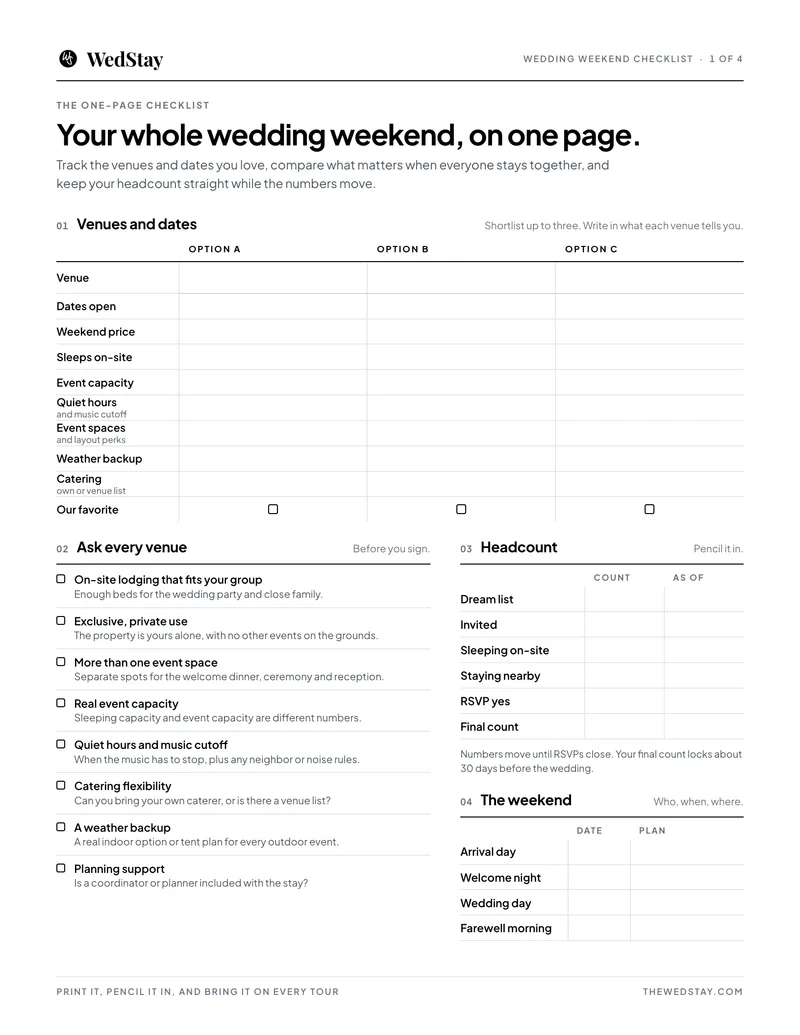
The format looks like this: guests arrive Friday afternoon to a welcome dinner. Saturday is the main event. Sunday morning wraps up with a farewell brunch that somehow turns into the most emotional meal of the entire weekend. Three days. One continuous celebration.
Celebrity influence made this happen. When Ben Affleck and Jennifer Lopez turned their Georgia estate wedding into a three-day celebration with yoga sessions, fireworks, and a candlelit rehearsal dinner, it sent a message. And when Brooklyn Beckham and Nicola Peltz did the same in Palm Beach, pre-wedding dinner Friday, ceremony Saturday, brunch Sunday, the three-day format became the blueprint.
Now here's what's changed for 2026. You don't need an 87-acre compound or a $76 million oceanfront mansion. You need a venue that lets you stay the whole weekend. A place with enough bedrooms for your inner circle. A kitchen or catering setup for all three meals. And zero curfew restrictions.
The math actually works in your favor. A multi-day wedding venue costs more upfront than a four-hour ballroom rental. But when you divide the total by the number of experience hours your guests actually get, the per-hour value is better. Way better. And your guests will talk about that Friday night bonfire for years.
Trend 2: Private Estate Takeovers
This is the trend that changed everything. And in 2026, it's not slowing down.
A private estate takeover means exactly what it sounds like. You rent the entire property. The house. The grounds. The pool. The kitchen. All of it. No other events happening that weekend. No shared spaces. No hotel guests in the lobby wondering what's going on.
It's your place for the weekend. Your rules. Your timeline. Your vibe.
The celebrity playbook here is long. Gwen Stefani and Blake Shelton got married on his 1,300-acre ranch in Oklahoma. They built a chapel on the property specifically for the ceremony. Chris Pratt and Katherine Schwarzenegger chose the San Ysidro Ranch in Montecito, a property so private that JFK and Jackie Kennedy honeymooned there decades earlier.
What these couples understood is that privacy changes the energy of a wedding. When you know nobody is watching except the people you invited, everyone relaxes. The couple relaxes. The parents relax. The photos look better because people aren't performing.
For 2026 couples, the estate takeover trend means looking beyond traditional wedding venues entirely. Browse estates on platforms built for this. Check the guest capacity, the event space, and whether you can bring your own vendors. That last part is huge, vendor freedom is where you save the most money and get the most creative control.
The couples booking estate takeovers in 2026 aren't just following a trend. They're choosing a totally different wedding experience. One that feels like a vacation with a ceremony in the middle.
Trend 3: Destination Micro-Weddings
Here's what happened: couples looked at the guest list, looked at the budget, and made a radical choice. Fewer people. Better location.
The destination micro-wedding is a 2026 powerhouse trend. We're talking 20 to 50 guests, a stunning location that doubles as the accommodation, and a celebration that feels more like a curated trip than a traditional wedding.
Millie Bobby Brown and Jake Bongiovi set the tone. After a small ceremony in the US, they held a second celebration in Tuscany for their closest people. The whole thing had the feel of an intimate gathering at an Italian villa, not a formal event with a seating chart and assigned tables.
The appeal is simple. When you have fewer guests, you can afford a better location. Instead of spending $40,000 on a 200-person ballroom event in your hometown, you spend $25,000 on a destination wedding with 40 guests at a property that makes everyone's jaw drop. The photos are better. The conversations are deeper. The memories are stronger.
In 2026, the most popular micro-wedding destinations are Tuscany, Tulum, the California coast, and the mountains of Colorado and Utah. Couples are choosing properties that sleep 10 to 20 people and hold ceremonies for up to 50. It's a full takeover at a fraction of the typical wedding cost.
The key? Finding a property where everyone stays together under one roof. That shared experience, making coffee together Saturday morning, swimming in the pool before the ceremony, staying up late around a fire pit, is what turns a small wedding into something unforgettable.
Trend 4: Main Character Energy Decor
You've seen this phrase everywhere. And in 2026 weddings, it's become an entire design philosophy.
Main character energy means your wedding looks and feels like a scene from a film. Not a generic banquet hall with white tablecloths and a DJ booth in the corner. A fully realized world that reflects who you are as a couple.
The celebrity influence here is massive. When Sofia Richie married Elliot Grainge at Hotel du Cap-Eden-Roc in the South of France, every detail, the flowers, the table settings, the outfit changes, told a story. The aesthetic was so specific and so consistent that the photos looked like editorial spreads. And they went everywhere online.
For everyday couples in 2026, main character energy doesn't mean spending a million dollars. It means being intentional. Pick one strong visual theme and commit to it. A color palette that shows up in the invitations, the flowers, the napkins, the cocktail garnishes. Custom signage. Statement lighting. An entrance moment that makes people gasp.
The venues that support this best are the ones with built-in character. A Tuscan castle has main character energy by default. A modern desert estate with floor-to-ceiling glass walls does too. A beige ballroom does not.
Couples in 2026 are choosing venues that do half the decorating work for them. When the backdrop is already stunning, you need less to make it look incredible. That's the real budget hack behind this trend.
Trend 5: The Desert and Mountain Elopement
If the multi-day estate wedding is one end of the 2026 spectrum, the desert and mountain elopement is the other. And both are booming.
The appeal is primal. Vast, open landscapes. No buildings. No parking lots. No fluorescent lighting. Just the couple, a small group of witnesses, and nature doing all the decorating.
Joshua Tree. Sedona. Big Sur. The Dolomites. Patagonia. These locations are pulling couples who want their wedding to feel raw and real. Not produced. Not polished. Just honest.
The elopement format in 2026 looks like this: the couple books a stunning property as home base. Maybe a cabin in the mountains or a desert escape with stargazing views. They get ready there. A photographer captures the morning. Then everyone drives to a ceremony spot, a cliff, a ridge, a meadow, for the vows. Back to the property for dinner. Done.
The whole thing costs a fraction of a traditional wedding. We're talking $5,000 to $15,000 total, including the photographer, the officiant, the flowers, and a few nights at the property. For couples who'd rather spend their money on the honeymoon or a house down payment, this math just works.
And thanks to social media, elopements don't feel like "less" anymore. A well-photographed desert elopement at golden hour gets more engagement than most 300-person ballroom weddings. The content is simply more compelling.
Trend 6: Sustainability as a Standard
One sustainable twist we love: instead of tossing the flowers, couples preserve them. Everlasting Bloom Co. turns your bouquet into a lasting keepsake.
This one has moved past "trend" territory. In 2026, sustainability is a baseline expectation for engaged couples under 35.
It's not about making a statement. It's about not wanting to produce a ton of waste for a single day. Couples are asking vendors about sourcing. They're choosing seasonal, local flowers over imported roses flown in from Ecuador. They're picking caterers who use local farms. They're skipping single-use plastics for the welcome bags.
The estate wedding format naturally supports this. When you stay at a property for the weekend, you reduce the transportation footprint. Guests aren't driving back and forth to a hotel every night. There's no fleet of shuttle buses burning fuel between the venue and accommodations. Everyone's already there.
Food waste drops too. When you're feeding 30 guests at a private estate versus 200 at a ballroom, portions are more precise. Leftovers are more manageable. Some couples are even composting on-site.
The flower conversation is shifting the most. Dried flowers and locally grown blooms are replacing those massive imported arrangements. Not because they're cheaper, though they often are, but because couples genuinely care about the environmental cost. A centerpiece that traveled 3,000 miles by air doesn't sit right with a generation that grew up with climate anxiety.
In 2026, sustainability isn't a selling point. It's a filter. Couples eliminate vendors who can't answer basic questions about sourcing and waste. The ones who survive that filter get booked.
Trend 7: TikTok-Worthy Moments
Let's be real about this one. Social media has fundamentally changed what couples care about when planning their wedding. And in 2026, designing for content is part of the process.
This doesn't mean every couple is creating a wedding for clout. It means they're thinking about moments. The first look. The entrance. The exit. The surprise. The reaction. These are the clips that get saved, shared, and rewatched. And couples are building them into the timeline on purpose.
The boutique venue revolution feeds directly into this. Unique venues produce unique content. A ceremony in front of a floor-to-ceiling mountain view? That's a clip. First dance under string lights at a private estate? Clip. Walking down a torch-lit path to a surprise after-party? Major clip.
Some of the most-shared wedding moments in the last year came from non-traditional venues. Not because the production value was higher, but because the settings were more visually interesting.
Here's the move for 2026 couples: walk through your venue and identify 3 to 5 spots that would make great content backdrops. The staircase. The garden gate. The sunset view from the terrace. Then build your timeline so the best moments happen in those spots at the right light.
You don't need a videography team with drones and sliders. You need a friend with a phone at the right place at the right time. The aesthetic of a great venue does the rest.
Trend 8: The WedStay-Style Wedding
Every trend on this list points to one thing: couples in 2026 want the whole property. Not a ballroom. Not a banquet hall. Not a tent in a field next to someone else's tent. The whole place.
This is what a WedStay-style wedding looks like. You book a stunning property. Your guests sleep under the same roof. You celebrate across three days in a space that belongs entirely to you. No curfews. No vendor restrictions. No sharing.
It's the celebrity model, scaled for real budgets.
Think about what Ben Affleck and J.Lo did on their 87-acre Georgia estate. Or how Gwen Stefani and Blake Shelton turned a ranch into a private wedding world. Or the way Millie Bobby Brown gathered her closest people at a Tuscan villa. All of these were WedStay-style weddings before the phrase existed. A place. A weekend. Your people.
The properties making this possible in 2026 range from $2,500 a night for an intimate desert escape to $30,000 a night for a 48-acre Los Angeles estate. There's something at every price point. And the total still tends to come in under what a traditional wedding venue charges after you add the catering minimums, the bar packages, and the service fees.
Use the venue cost calculator to see the real numbers. Compare a hotel wedding package against an estate rental with your own vendors. The difference usually shocks people.
Here are five properties that show exactly what's possible in 2026:
🌴 Hidden Tulum Oasis
Tulum, Mexico · Sleeps 17
🏛️ Iconic LA Estate
Los Angeles, California · Sleeps 26
🏰 Chianti Castle
Chianti, Tuscany · Sleeps 18
🌵 Joshua Tree Escape
Yucca Valley, California · Sleeps 4
🌊 Big Sur Oceanfront
Big Sur, California · Sleeps 10
Celebrity Couples Who Chose Private Estates
The private estate wedding isn't a fringe choice anymore. It's what the biggest names in entertainment have been choosing for years. And their reasoning is the same as yours: privacy, freedom, and a celebration that actually feels personal.
Here are seven celebrity couples who skipped the traditional venue and went with a private property instead.
Ben Affleck & Jennifer Lopez (2022), After eloping in Las Vegas, Bennifer held their second ceremony at Affleck's 87-acre estate on Hampton Island Preserve near Savannah, Georgia. The property overlooks the North Newport River and hosted a full weekend celebration with fireworks, yoga sessions, and a candlelit rehearsal dinner. Three hundred guests. Three days. One estate.
Chris Pratt & Katherine Schwarzenegger (2019), The couple chose the San Ysidro Ranch in Montecito, California. The property is famous for its extreme privacy and has history, JFK and Jackie Kennedy honeymooned there. Both the bride and groom wore custom Giorgio Armani. The guest list was small and intentional.
Jennifer Lawrence & Cooke Maroney (2019), Lawrence married her art dealer husband at Belcourt of Newport, a Gilded Age mansion in Rhode Island designed in 1894 to look like a French hunting lodge. The 150-guest event included Amy Schumer, Emma Stone, and Adele among the attendees.
Gwen Stefani & Blake Shelton (2021), The couple married on Shelton's 1,300-acre ranch in Oklahoma, where he built a chapel on the property specifically for the ceremony. Carson Daly officiated. Shelton sang his own song as part of his vows. Stefani wore custom Vera Wang. The whole thing was intimate, personal, and completely on their terms.
Brooklyn Beckham & Nicola Peltz (2022), This three-day celebration took place at the Peltz family's $76 million oceanfront estate in Palm Beach, Florida. The 44,000-square-foot mansion, called Montsorrel, hosted 300 guests across a weekend that included a pre-wedding dinner, the ceremony, and a Sunday brunch. Guests included Serena Williams, Eva Longoria, and Tom Brady.
Zoe Kravitz & Karl Glusman (2019), Kravitz married at her father Lenny Kravitz's mansion in Paris. The intimate ceremony had the feel of a private dinner party rather than a formal wedding. The location, a personal family home rather than a rented venue, gave the celebration an authenticity that's hard to replicate in a commercial space.
Millie Bobby Brown & Jake Bongiovi (2024), After a small private ceremony in the US, the couple held a second celebration at a villa in Tuscany. Brown's Stranger Things co-star Matthew Modine officiated. The whole event felt like an intimate gathering of close friends in the Italian countryside, with local food, natural light, and zero corporate venue energy.
The pattern is clear. These couples had unlimited budgets. They could have booked any ballroom, any resort, any five-star hotel on the planet. They chose private estates instead. That tells you everything about where weddings are headed.
Start browsing exclusive-use wedding estates to see what's available for your dates.
FAQ
Are celebrity wedding trends realistic for normal budgets?
Yes, and that's the whole point of this list. The trends celebrities set, multi-day weekends, private estates, micro-weddings, elopements, are all more accessible than you'd think. A three-day estate wedding for 40 guests can cost less than a one-day hotel wedding for 200. The WedStay venue matcher helps you find properties at every price point.
How much does a private estate wedding actually cost?
It depends on the property and the guest count. Intimate desert elopement properties start around $2,500 per night. Mid-range estates with 10 to 20 bedrooms run $5,000 to $10,000 per night. Large luxury estates for 100+ guest events range from $15,000 to $30,000 per night. Use the cost calculator to compare against traditional venue pricing, the estate usually wins.
What's the biggest wedding trend for 2026?
The multi-day, full-property takeover. Couples want the venue to themselves for the entire weekend. They want their guests under one roof. And they want total control over vendors, timeline, and vibe. Everything else on this list, the decor, the content strategy, the sustainability focus, builds on top of that foundation.
Can I have a WedStay-style wedding with a small budget?
Absolutely. A WedStay-style wedding scales to your guest count and location. A cabin elopement for 4 guests costs $2,500 a night. A desert property for 20 guests runs $3,000 to $5,000. When you bring your own vendors and skip the venue markup, the total often comes in under $15,000 for small weddings. Browse options on the DIY wedding checklist page to start planning.
Ready to plan a wedding that feels like something out of a movie? Browse all-inclusive wedding venues on WedStay and find the property that fits your style, your guest count, and your budget. Your perfect venue is already out there, you just need to find it.
Ready to Find Your Dream Venue?
I know how overwhelming venue hunting can be (trust me, I've been there!). That's why I created this free tool to cut through the confusion:
Try Our Free Wedding Venue Cost Calculator
- Wedding Venue Cost Calculator
- No email required - get instant results!
While you're here, these might help too:
- A Private Estate Wedding House Just Outside Nashville, Complete with an Event Barn, Scenic Views, and Room to Celebrate All Weekend Long
- Palm Springs Wedding Estate with Retro Pool Vibes + Hollywood History: Your Multi-Day Celebration Destination
- It’s Giving Main Character Energy: How to Host a Wedding That Feels Like a Movie
Happy planning! 💕
Sources
1. 2025 Wedding Technology Trends · theknot.com
2. 15 Wedding Technology Trends Taking 2025 by Storm · brides.com
3. Real Weddings, Real Wedding Photos · brides.com
4. Wedding Inspiration from Real Weddings in Vogue · theknot.com