The Wedding Venue Checklist: 47 Questions to Ask Before You Book (Your Printable 2026 Guide)

Quick Navigation
- How to Use This Checklist
- Capacity and Layout
- Pricing and Contracts
- Vendor Policies
- Amenities and Logistics
- Lodging and Guest Experience
- Rules and Restrictions
I've toured over 300 venues in my career. Signed contracts at about 80 of them on behalf of clients. And I can tell you this: the couples who show up with a checklist get better answers, better pricing, and fewer surprises than couples who just wing the tour.
This is the exact list I hand my clients before every venue visit. Forty-seven questions. Every one earned a spot because I've watched a couple get burned by not asking it. Print it out. Pull it up on your phone. Bring it to every tour. You're about to write a five-figure check. You deserve answers.
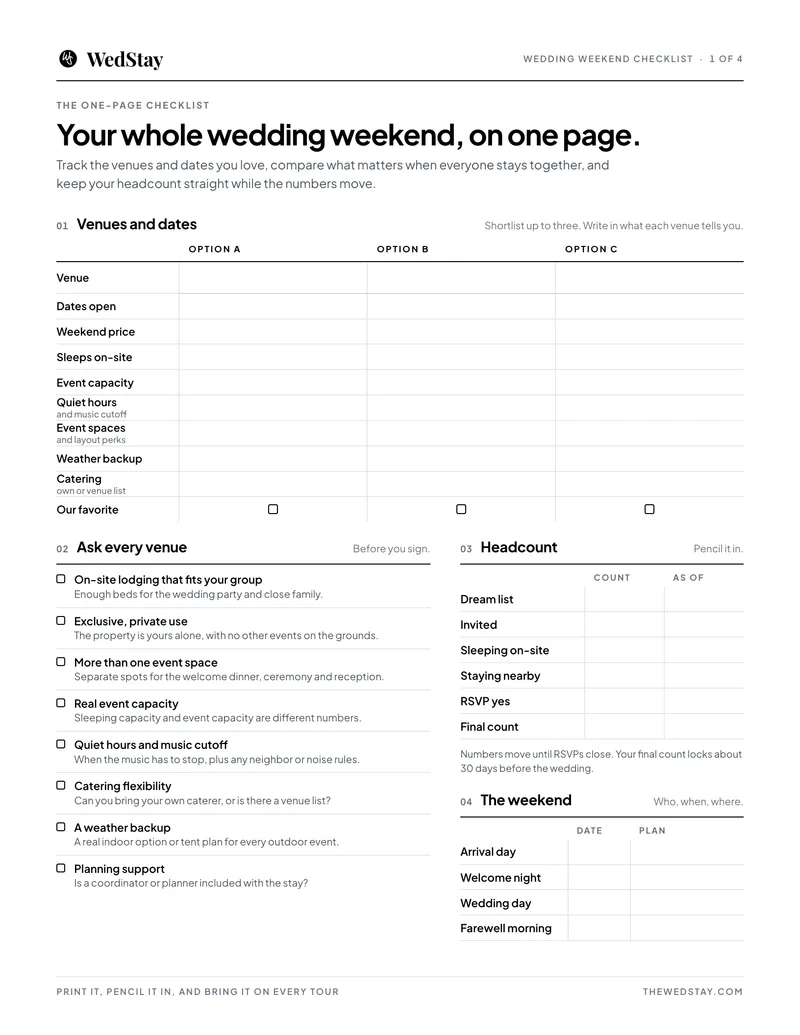
The tour is a sales pitch. The coordinator's job is to make you fall in love with the space. Your job is to find out if the space can actually deliver on your wedding day. Use the WedStay venue cost calculator to plug in the answers as you go.
How to Use This Checklist
You don't need to ask all 47 questions at every tour. But you should ask all 47 at your top three venues before signing anything.
Here's my system:
- First tour: Ask capacity, pricing, and vendor policy questions. These are deal-breakers.
- Second tour (top 3 venues): Ask amenities, logistics, lodging, and restriction questions. Bring your partner.
- Before signing: Ask estate-specific questions and review the red flags section.
Write the answers directly on this checklist. If a venue can't answer a question or dodges it, that is an answer. Write that down too.
Pro Tip: Bring a second person to the tour. You'll be looking at the sunset views. They'll notice the parking lot only has 30 spaces and the bathrooms are across a gravel path.
Capacity and Layout
These are the questions that eliminate venues fast. If the numbers don't work, nothing else matters. I start here because I've seen couples fall in love with a venue that physically cannot hold their guest list. Get these answers first.
☐ What is the maximum guest capacity for ceremony? For reception?
These numbers are often different. A venue might hold 200 for a standing cocktail hour but only seat 120 for dinner. Get both numbers in writing.
☐ Is there a separate space for cocktail hour?
If cocktail hour and reception happen in the same room, your team needs a full flip between events. That takes 45-60 minutes minimum. Ask where your guests go during that time.
☐ What does the rain plan look like?
Ask to see the actual backup space, not just hear about it. A "tent option" means nothing until you know who pays for the tent and how much it costs. I've seen rain plans that cost an extra $8,000.
☐ Can we see the space set up for a wedding?
Website photos are styled. Ask for photos from real weddings, not styled shoots. Better yet, ask to visit during or right after an actual event.
☐ Where does the dance floor go? What size is it?
A dance floor should be roughly 4.5 square feet per guest. For 100 guests, that means you need a 450-square-foot dance floor. Not all spaces can fit that plus tables. Do the math before you sign.
☐ Is there a bridal suite or getting-ready room?
You need somewhere to get ready that isn't a bathroom. Ask about lighting, mirrors, distance from the ceremony site, and how many people it holds. Your hair and makeup team needs space too.
☐ What does the ceremony site look like?
Ask about aisle width, seating setup, and sun direction at your ceremony time. Sun in your guests' eyes at 4 PM is a real problem that nobody mentions during a morning tour.
☐ How accessible is the venue for elderly or disabled guests?
Ask about stairs, gravel paths, ADA-compliant bathrooms, and elevator access. If Grandma can't get to her seat without climbing stairs, you need to know that now.
☐ Is there a backup power source?
Outdoor and estate venues don't always have enough outlets for a DJ, lighting, and catering equipment. Ask about power capacity, generator availability, and who pays for it.
☐ Where do guests park?
How many spaces? Is there overflow parking? How far is the lot from the venue? At some estate wedding venues, parking is right on the property. At others, it's a quarter mile down the road.
Red Flag 🚩
If the venue can't give you a specific number for maximum capacity and says something like "it depends" or "we're flexible," that usually means they've never had it officially measured or they're willing to overpack the space. Get a number. In writing.
Pricing and Contracts
This is where venues make their money and where couples lose theirs. I've seen the gap between quoted price and final invoice run as high as 40%. For a deeper look at real venue pricing, read I Called 100 Wedding Venues Pretending to Be Engaged.
☐ What is the total venue rental fee?
Not the "starting at" price. The actual fee for your date, your guest count, your time frame. Get the number that will appear on your contract.
☐ What is included in that fee?
Tables, chairs, linens, setup, cleanup, coordination, parking, security? Make a list of what's included and what's extra. Properties like the 40-Acre San Diego Resort include pools, hot tubs, and lawn spaces in the rental. Others charge you for a folding chair.
☐ Are there food and beverage minimums?
Hotel venues and many traditional venues require a minimum spend on catering, often $15,000-$50,000. If your guest count is small, that minimum gets expensive fast. Ask if the minimum applies to the bar as well.
☐ What's the service charge and gratuity?
A 22% service charge plus 20% gratuity on top of catering minimums can add $7,000-$10,000 to your bill. Ask whether the service charge goes to staff (it often doesn't) and whether gratuity is mandatory or suggested. Use the vendor cost calculator to model the full picture.
☐ What's the payment schedule?
Know when every payment is due. Most venues require 25-50% upfront with the balance due 30-90 days before the event.
☐ What is the cancellation and refund policy?
Read every word of this section. Ask about partial refunds, date transfers, and force majeure clauses. No force majeure clause after 2020? That's a red flag.
☐ Are there overtime fees?
Most venues have an end time. Going past it costs $500-$2,000 per hour. Ask what the end time is, what overtime costs, and whether there's a hard cutoff or just a fee.
☐ Is the price locked, or can it change before the wedding?
Some venues include escalation clauses that allow price increases for weddings booked more than a year out. Read the contract carefully and ask specifically about price guarantees.
Red Flag 🚩
If the venue refuses to provide an itemized breakdown of costs and just gives you a "package price," push back. You have the right to know exactly what you're paying for. Bundled pricing hides markups. Every single time.
Vendor Policies
Vendor flexibility can save you thousands or cost you thousands. The difference between bringing your own caterer and using in-house can be $10,000+ for 100 guests. For more, read The Ultimate Wedding Vendor Guide.
☐ Can we bring our own caterer?
Some venues require in-house catering. Others allow outside caterers but charge a kitchen fee ($500-$2,000). Know your options and what the outside caterer fee covers.
☐ Can we bring our own alcohol?
In-house bar packages run $50-$100 per person. BYOB with a hired bartender runs $15-$30 per person. That's a $5,000-$7,000 difference for 100 guests. Estate-style venues and private properties almost always allow it.
☐ Is there a preferred vendor list? Is it required or suggested?
A "preferred" list that's actually required means those vendors pay the venue a referral fee. That cost gets passed to you.
☐ Can we choose our own DJ, photographer, and florist?
Some venues restrict specific vendor categories. A venue that lets you bring your own caterer but requires their AV company can still inflate your costs.
☐ What are the vendor load-in and load-out times?
Your florist needs 3-4 hours. Your caterer needs 2-3 hours. Your DJ needs 1-2 hours. If the venue only allows a 4-hour setup window, someone's going to be rushed. Rushed vendors make mistakes.
☐ Are there vendor meal requirements?
Most venues require you to feed your vendor team. Ask how many vendor meals and the cost per meal. Some venues charge full guest pricing ($150+) for vendor meals.
Amenities and Logistics
Nobody talks about bathrooms and parking during the dreamy venue tour. But your grandmother will talk about the port-a-potty situation for the next five years.
☐ How many bathrooms are available for guests?
Industry standard is one toilet per 35 guests. For 100 guests, you need at least three. If the venue doesn't have enough, ask about luxury restroom trailers. They cost $800-$2,000 to rent and are worth every penny.
☐ Is there WiFi?
Your DJ might need it for streaming. Your photographer needs it for backups. Rural estates don't always have reliable internet.
☐ Is there cell service?
If your venue is in a dead zone, guests can't call rideshares and your coordinator can't reach vendors. Visit the venue and test it with your own phone.
☐ What's the kitchen situation?
If you're bringing an outside caterer, they need a functional kitchen or at least a prep area with running water, counter space, and power. Ask your caterer what they need and then ask the venue if they can deliver it.
☐ Is there climate control?
Air conditioning in July. Heating in November. Both matter more than you think. Outdoor venues should have shade structures and fan options for summer. Properties like the Wine Country Hacienda in Fallbrook offer both indoor and outdoor spaces so you can shift based on weather.
☐ What happens if something breaks or goes wrong during the event?
Is there a property manager on-site? An emergency contact? If something breaks at 9 PM on a Saturday, you need to know who to call.
☐ Is there lighting for evening events?
String lights and candles are beautiful. They're also not enough to see your dinner. Ask what the venue provides versus what you need to rent.
☐ Where do deliveries go?
Flowers, rentals, cake, alcohol all show up at different times. Ask about driveway access and who receives deliveries if you're not there yet.
Lodging and Guest Experience
Where your guests sleep affects everything: how late they stay, whether they drink freely, and the entire vibe of a wedding weekend.
☐ Can guests stay on-site?
On-site lodging changes the entire dynamic. No one worries about driving. The celebration continues around the fire pit. This is why the WedStay model exists. Properties like the Florida Keys Wedding Village sleep up to 260 guests across 26 villas.
☐ How many guests can the venue sleep?
Get the real number, not the "we can fit air mattresses in the living room" number. How many proper beds? How many bedrooms?
☐ What are the nearest hotels and how far away are they?
Ten minutes is fine. Forty minutes means people leave early. Get names, distances, and whether the venue has a room block arrangement.
☐ Is there shuttle or transportation available?
A shuttle for 50 guests runs $1,000-$2,500 for the evening. Figure this out before the wedding, not during cocktail hour. Use the wedding budget planner to build transportation into your budget from the start.
☐ What's the check-in and check-out process?
If the venue has lodging, ask when guests can arrive and when they need to leave. Early check-in and late checkout can extend your celebration. A noon checkout the morning after your wedding is brutal.
Rules and Restrictions
The goal isn't finding a venue with no rules. It's finding one whose rules work with your vision. Read about common Airbnb wedding mistakes before you tour any private property.
☐ What's the noise cutoff time?
Most residential areas have noise ordinances. If the venue says music stops at 10 PM, that's your hard limit. Ask if this is a legal requirement or a venue preference because there's usually no flexibility on the legal ones.
☐ Are there decoration restrictions?
No open flames. No confetti. No tape on walls. No stakes in the lawn. Get the full list in writing before you start planning decor.
☐ Are there fireworks, sparkler, or open flame restrictions?
Sparkler exits look amazing on Instagram. They're also banned at many venues due to fire risk or insurance requirements. Ask specifically. Don't assume.
☐ Can we have a ceremony and reception at the same location?
Some venues only allow receptions or only allow ceremonies. Having both at one location saves transportation costs, simplifies logistics, and gives you more time with your guests.
☐ Are there restrictions on wedding timing or day of the week?
A Friday wedding at your dream venue might cost 30-40% less than Saturday. Ask about every option.
Red Flag 🚩
If the venue says they have "flexible rules" but won't put them in writing, the rules are whatever they decide on the day of your event. Get everything documented in the contract. Verbal promises mean nothing when your DJ gets shut down at 9:30 PM.
The Estate-Specific Questions
If you're looking at private estates or exclusive-use venues through platforms like WedStay, these five questions are critical. The freedom is incredible, but it means you need to ask different questions. For context, read our traditional venue vs estate cost breakdown.
☐ Does the property allow events?
Not every rental property allows weddings. "Allows events" can mean 20 people or 200. WedStay properties are specifically vetted for weddings, which eliminates this guesswork.
☐ What permits or insurance do we need?
Many municipalities require event permits for gatherings over a certain size. You may also need event liability insurance ($150-$300 for a one-day policy). Ask who handles permits and whether the property already has an event use permit on file.
☐ Who handles setup and cleanup?
At a traditional venue, the staff handles this. At an estate, it might be you. Ask about cleanup fees and what "leaving it as you found it" actually means. Some WedStay buyout properties include coordination support.
☐ Is the property exclusively ours for the duration?
No other events, no strangers walking through your reception. Ask if exclusive use is included or an add-on. Properties like the NJ/NY Wedding Estate give you the entire property. That privacy changes the feel of the whole weekend.
☐ What's included versus what do we need to rent?
Tables, chairs, linens, sound system, lighting, lawn games. Traditional venues often include most of this. Estates usually don't. The savings on venue rental can go right back into rental equipment if you're not prepared.
Red Flags: Answers That Should Make You Walk Away
I've walked clients out of venue tours. More than once. Here's what I look for after 200+ weddings.
They won't let you see the contract before the tour. A venue that wants your deposit before you've read the fine print is not protecting your interests. Take the contract home. Have someone else read it.
The quoted price doesn't include taxes and fees. A $10,000 quote becomes $14,600 after a 22% service charge, 9% tax, and $1,500 in miscellaneous fees. A 46% increase nobody mentioned. This happens all the time.
There's no force majeure clause. After 2020, every contract should protect you from events beyond your control. If they refuse to add one, walk.
They rush you toward a deposit. "This date won't last" is the oldest pressure tactic in the business. Good venues hold your date for 48-72 hours. Great venues give you a week.
The reviews mention hidden fees. Check Google Reviews, Yelp, and The Knot. If three different couples mention surprise charges, it's not a coincidence. It's a business model.
The coordinator can't answer basic questions. Capacity, pricing, and vendor policies should get immediate answers. If they need to "check with the owner" on everything, that disconnect causes problems all the way through planning.
They don't have liability insurance. One slip-and-fall at your reception and you could be personally liable. Ask. If they seem confused by the question, that's your answer.
Frequently Asked Questions
How many venues should I tour before deciding?
Five to seven. Fewer than five and you don't have enough data. More than seven and they blend together. Use the WedStay venue matcher to narrow your list before touring.
When should I start visiting venues?
Twelve to fourteen months out for peak season (May through October). If you're flexible on dates, eight to ten months is fine. Estate properties through WedStay tend to have more availability than traditional venues.
Should I negotiate the venue price?
Yes. Always. Ask about off-peak discounts (Friday or Sunday weddings, winter dates) and multi-day booking discounts. I've saved clients 15-25% just by asking. The DIY wedding checklist has more strategies for keeping costs down.
What's the difference between a venue coordinator and a wedding planner?
A venue coordinator works for the venue. A wedding planner works for you. The coordinator manages the space and enforces rules. The planner manages every vendor, handles the full timeline, and advocates for your interests. Venue coordination saves you $1,000-$2,000 but does not replace a planner. Check the WedStay vendor marketplace to find planners who specialize in estate venues.
Ready to Find Your Dream Venue?
I know how overwhelming venue hunting can be (trust me, I've been there!). That's why I created this free tool to cut through the confusion:
Try Our Free Wedding Venue Cost Calculator
- Wedding Venue Cost Calculator
- No email required - get instant results!
Don't miss these related guides:
- I Called 100 Wedding Venues Pretending to Be Engaged, Here's The Real Cost Breakdown They Don't Want You to See
- A Private Estate Wedding House Just Outside Nashville, Complete with an Event Barn, Scenic Views, and Room to Celebrate All Weekend Long
- Swipe Right for Your Dream Wedding Venue: How WedStay's Revolutionary Venue Matcher Changes Everything
Happy planning! 💕
Sources
1. What vendors do you need for a wedding? This free printable wedding vendor checklist template... · theknot.com
2. Best Man Wedding Duties: The Ultimate Checklist · theknot.com
3. Your Ultimate Wedding Registry Checklist | Lace & Favour · brides.com
4. Wedding Checklists & Timeline · marthastewart.com
5. Real Weddings, Real Wedding Photos · brides.com
6. The Etiquette of Wedding Rehearsal Dinners · marthastewart.com
7. Elite Wedding Venues for Preppy Couples · townandcountrymag.com
Transparency: this post contains a partner link. Book through it and WedStay may earn a commission at no extra cost to you. Nothing gets linked unless we would recommend it anyway.