How to Market Wedding Rental Properties in 2026

To market wedding rental properties in 2026, you need to do three things in order: position your property as a private wedding venue instead of a group stay, price it as a multi-day total that captures wedding budgets instead of lodging budgets, and promote it on the specific channels where engaged couples search (wedding marketplaces, search engines, AI answer tools, and short-form video). That's the whole playbook. Everything else in this guide is the math, the sequencing, and the mistakes to avoid at each step.
I'm going to be blunt about why this matters. The average American wedding now runs about $36,000 according to Zola's 2026 Cost Index, and the venue is the single biggest line item: $8,573 on average, with typical spend running $6,900 to $10,300. The Knot's most recent Real Weddings Study puts average venue spend even higher, north of $12,000. Roughly 2 million couples get married in the US every year, and they are actively moving away from ballrooms toward exactly the kind of property you own. The demand is real. The question is whether couples can find you, and whether your listing gives them a reason to pay venue money instead of lodging money.
I analyze wedding spending data for a living, and I've spent the last two years helping rental owners reposition properties for wedding weekends. Confession time: my first attempt at this went badly. I helped a friend "market" his lake house for weddings in 2023 by adding the word "weddings welcome" to his existing listing and boosting a few social posts. Total new wedding bookings after four months: zero. The problem wasn't the property. The problem was that we promoted before we positioned. Don't repeat my mistake. Follow the order.
Quick Navigation
- How to Market Wedding Rental Properties in 2026
- Know the 2026 Market Before You Spend a Dollar
- Position Your Property as a Venue, Not a Group Stay
- Price for the Wedding Buyer, Not the Weekend Guest
- Build a Listing That Sells the Whole Weekend
- Promote Where Couples Actually Search
- Turn Planners and Vendors Into a Referral Engine
- Reviews and Proof: Your Cheapest Marketing Channel
- Marketing Mistakes That Kill Wedding Bookings
- A 90-Day Marketing Plan You Can Actually Run
Key Takeaways
- Position, price, and promote in strict order, since promoting a generic listing multiplies confusion instead of bookings.
- Venues average $8,573 per Zola and over $12,000 per The Knot, so price as a multi-day wedding total, not a nightly rate.
- Barns, farms, and ranches already host about 17 percent of receptions as couples shift away from ballrooms toward private properties.
- Roughly 35,800 US venues exist, but rentals with lodging compete in the thinner private estate category, where hotels cost 2.5 times average.
- One owner's inquiries fell by a third but bookings tripled after switching to an itemized 2-night wedding total.
How to Market Wedding Rental Properties in 2026
Here's the framework I use with every owner I work with. Three stages, in strict order.
Stage 1: Position. Decide what wedding your property is for, and rebuild your listing, photos, and copy around that single answer. A property that "can host events" is invisible. A property that hosts "50-guest garden ceremonies with lodging for 16" gets inquiries.
Stage 2: Price. Build a wedding rate as a total for a 2-night minimum (or 3-night, if that's your requirement) that bundles lodging plus event use. Wedding buyers compare your total against venue quotes, not against other rentals.
Stage 3: Promote. Put the positioned, priced listing in front of couples on the channels they actually use in 2026: wedding-specific marketplaces, Google and AI answer engines, short-form video, and planner networks.
Why this order? Because promotion multiplies whatever it touches. If you promote a generic listing, you multiply confusion. If you promote a sharp one, you multiply bookings. The data shows couples book venues fast once engaged (most lock a venue within a few months, per Cvent's venue marketing research), so when your listing finally lands in front of the right couple, it has one shot to read as "this is our venue" instead of "this is a nice house."
The rest of this guide walks through each stage with real numbers.
Know the 2026 Market Before You Spend a Dollar
Okay, quick tangent, but this one pays for itself. Before you write a single line of listing copy, you should know what you're selling into. I pulled the current numbers so you don't have to.
The demand side. About 2 million US weddings happen annually. Zola's 2026 Cost Index puts the average total at roughly $36,000, with venue and site fees averaging $8,573. The Knot's Real Weddings Study (based on more than 10,000 surveyed couples) reports average venue spend above $12,000. Regionally, the spread is wide: Mid-Atlantic weddings average around $48,400 total while the Midwest averages about $29,000. Price your marketing expectations to your region, not the national headline.
The trend that favors you. The Knot's 2026 trend report says it flat out: ballrooms and traditional banquet spaces are losing share to unconventional venues, including historic estates, gardens, and private properties. Barns, farms, and ranches already host about 17 percent of receptions. Couples increasingly want a place that doesn't look like every other wedding they've attended, plus lodging so the celebration lasts a whole weekend instead of five hours. That pull between a one-of-a-kind property and a traditional venue can genuinely split a couple down the middle, and this r/weddingplanning thread captures the argument in real time, right down to commenters urging the pair to settle their guest count before touring anything.
The competition side. There are roughly 35,800 dedicated wedding venues operating in the US, concentrated in Texas (about 3,900), California (about 3,650), and Florida (about 2,400). Sounds crowded. It isn't, for you, because you're not competing in the "banquet hall with a Saturday slot" category. A rental property with lodging competes in the "private estate wedding weekend" category, where supply is thin in most markets and hotel alternatives cost multiples more (Zola's survey data shows hotel weddings run about 2.5 times the national venue average).
The generational split. Gen Z couples average around $27,000 per wedding with bigger guest lists, while Millennial couples average over $51,000 with smaller ones. Translation for your marketing: if your property sleeps a lot of people but has modest event space, you're a Gen Z value play. If it's smaller and stunning, you're a Millennial intimate-wedding play. Know which one you are before you write a word.

Position Your Property as a Venue, Not a Group Stay
Positioning is the highest-ROI marketing work you will do, and it costs nothing but thinking time.
A group-stay listing says: sleeps 14, hot tub, close to hiking. A venue listing says: ceremony lawn faces west for sunset vows, reception patio seats 60, couple's suite has morning light for getting-ready photos, and your people stay all weekend. Same property. Completely different buyer, and completely different budget category. Wedding buyers have venue money. Lodging buyers have lodging money. Your copy decides which wallet opens.
Here's how to find your position. Answer these four questions in writing:
- What is the one ceremony spot? Not "several beautiful areas." One spot, named and photographed. The oak at the pond. The bluff over the water. Couples imagine one moment first; give them the picture.
- What guest count do you actually serve well? Be honest. If parking, septic, and noise rules cap you at 50, market 50 and dominate the intimate-wedding search. Overpromising 150 gets you inquiries you'll refund and reviews you'll regret.
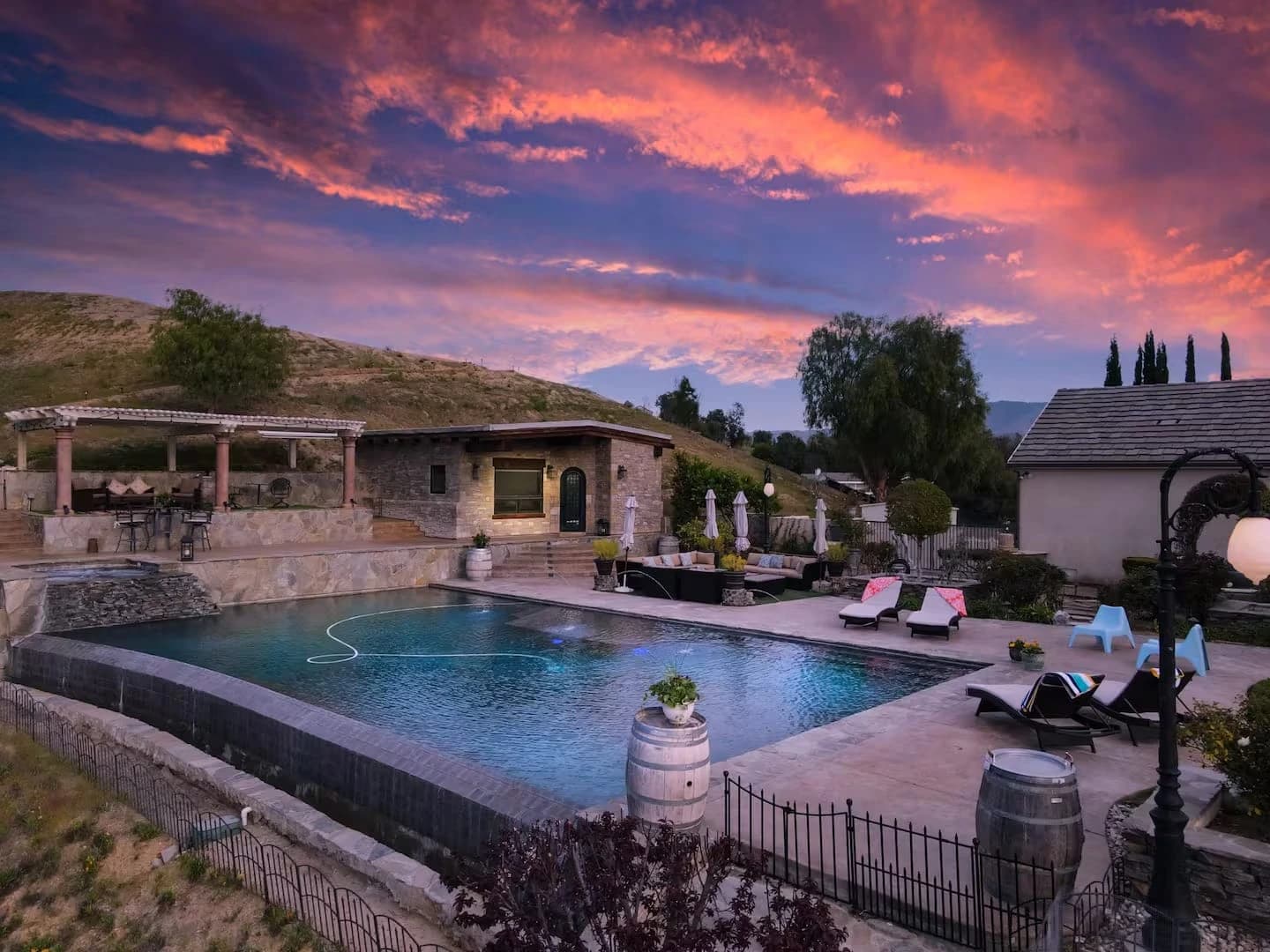
- What can couples do here that they can't do at a banquet hall? This is your differentiation, and specific beats grand. A working example from the WedStay marketplace: this San Diego cattle ranch in Poway markets a fully operational equestrian center. Horses at golden hour is not a feature a hotel can copy, and every photo and sentence in that listing leans into it.
- Who is the wrong couple for you? Write it down privately. Saying no to 150-guest inquiries when you're a 40-guest property keeps your reviews clean, and reviews are marketing (more on that below).
Real talk: most owners resist narrowing because it feels like turning away money. The math says otherwise. A focused listing converts a higher percentage of a smaller, better-fit inquiry pool, and fit is what produces the five-star reviews that compound into next year's bookings. Broad positioning is how you end up as everyone's second choice.
Price for the Wedding Buyer, Not the Weekend Guest
Pricing is marketing. The number on your listing tells couples what category you're in before they read a word.
First rule, and it's non-negotiable on WedStay: quote totals for your minimum stay, never a nightly rate. Wedding buyers don't think in nights. They think "the venue line in our budget is $10,000, what does that get us?" So your listing should say something like "$8,500 total for a 2-night weekend, up to 50 guests, event use included." A total invites comparison against venue quotes, where you look strong. A nightly rate invites comparison against regular rentals, where your event premium looks like gouging.
Second, anchor against what couples actually pay elsewhere. National average venue spend sits between roughly $8,600 and $12,000+, and that usually buys a single day with a hard end time. Industry revenue data shows space-only venues charging $3,000 to $8,000 per event, and bundled venue-plus-catering packages running $12,000 to $25,000 or more. Your property delivers the venue plus two or three nights of lodging for the couple and their closest people. When your listing spells out that comparison ("your venue and your accommodations, one total"), you're not expensive anymore. You're the value play in the premium category. WedStay's wedding venue cost calculator is a useful reference here; run your own market through it and set your total against what couples in your region actually budget.
Third, build the total from real components so you can defend it in inquiry conversations:
- Base lodging value for your minimum stay (what you'd earn from a normal group booking)
- Event premium (wear, setup and teardown days, noise risk, extra cleaning, insurance)
- Included capacity (tables, chairs, parking, restrooms if you provide them)
Wait, I should mention the thing everyone asks: "Won't a high total scare couples off?" The data I've seen across owner clients says the opposite. Underpriced event listings attract party inquiries and scare off serious couples, who read a suspiciously low number as "this owner doesn't understand weddings, and my caterer will find that out the hard way." Serious buyers are reassured by a confident, itemized total. My friend with the lake house? Once we rebuilt his price as a 2-night wedding total with an included-capacity list, his inquiry volume dropped by a third and his booking rate tripled. Fewer, better conversations.

Build a Listing That Sells the Whole Weekend
Your listing is your storefront, and in 2026 it gets read by two audiences: humans and machines. Both matter. Here's what the human-facing part needs.
Photos in wedding order. Lead with the ceremony spot, then the reception area set for an event, then the getting-ready space, then lodging. Most rental listings lead with the kitchen. Couples don't marry in the kitchen. If you've never hosted an event, stage one: rent 20 chairs and an arch for an afternoon and shoot the setup. One staged photo outperforms ten empty-lawn photos because it does the imagining for the buyer. Look at how this Santa Cruz Mountains villa presents its event spaces against those Monterey Bay views: the photos answer "where do we say our vows" before the couple ever asks.
Copy that answers the six planner questions. Capacity, event hours and noise cutoff, vendor policy (open or preferred list), power and water access for caterers, parking count, and rain plan. Every inquiry you get will ask these. Answering them in the listing filters out bad fits for free and signals to good fits that you run a professional operation.
The weekend narrative. This is the piece most owners skip, and it's the piece that justifies your total. Walk the couple through Friday welcome dinner on the patio, Saturday ceremony and reception, Sunday recovery brunch before checkout. You're not selling a space for six hours. You're selling the whole celebration, with the people they love sleeping under the same roof. That story is the entire economic argument for a wedding rental over a banquet hall, so tell it explicitly.

Promote Where Couples Actually Search
Now, and only now, promotion. Four channels earn your effort in 2026, ranked by conversion quality.
1. Wedding-specific marketplaces. The highest-intent channel by a wide margin, because everyone searching there is planning a wedding. Generic rental platforms bury event properties (and many prohibit events outright), while venue directories built for banquet halls have nowhere to put your lodging. List where the category matches what you sell: WedStay's property owner page exists specifically for wedding-ready rentals, and listings there are structured around the questions couples ask (capacity, event use, sleeping arrangements, multi-day totals). Analysis reveals a simple truth about channel strategy: one listing seen by 500 engaged couples beats one seen by 50,000 vacation shoppers.
2. Search and answer engines. Couples in 2026 don't just Google "wedding venue near me." They ask ChatGPT and Google's AI results things like "private estate wedding venue in the Hudson Valley with lodging for 20." Those tools assemble answers from structured, specific, consistent text on the open web. You influence them the same way you influence classic SEO: a listing (and ideally a simple property website) that states your location, capacity, guest count, and wedding use in plain sentences; consistent naming everywhere your property appears; and a Google Business Profile if you operate openly as a venue. Machines can't cite what you never wrote down.
3. Short-form video. TikTok and Instagram Reels are where couples collect venue ideas before they ever search. You don't need to be a creator. You need three recurring clips: the ceremony-spot walkthrough at sunset, a setup time-lapse from any event, and a property tour narrated with your guest count and location. Post steadily, tag your region and "wedding venue," and let the algorithm find couples in the daydreaming phase. One owner I work with gets a third of her inquiries from a single walkthrough video that took eleven minutes to film.
4. Real weddings as content. After every event (with the couple's permission), get the professional photos and publish them: on your listing, your socials, and submitted to local wedding blogs and publications. Editors need real-wedding features constantly, and a published feature earns you a backlink, borrowed trust, and photography you didn't pay for. This channel compounds; by wedding five, you have a portfolio no ad budget can fake.
Notice what's not on the list: paid ads. I'm not against them, but paid traffic aimed at an unproven listing is the most expensive way to learn your positioning is off. Earn organic conversions first, then use ads to pour fuel on a listing that already converts.
Turn Planners and Vendors Into a Referral Engine
Here's a number that should change your marketing budget: a wedding planner who likes your property can send you multiple bookings every single year, indefinitely. No other channel has that repeat rate.
Planners are professionally obligated to know venues, and they are actively hunting for private properties because their clients keep asking for them. Make their job easy:
- Build a one-page venue sheet. Capacity, dimensions of usable spaces, power and water locations, parking count, noise ordinance and cutoff time, insurance requirements, and your 2-night total pricing. PDF, emailed on request. Planners talk to each other, and "the owner who had answers" is a reputation that spreads.
- Host a walkthrough. Invite five local planners and photographers for coffee and a property tour on a slow morning. Cost: almost nothing. I've watched a single walkthrough morning turn into three bookings within a year.
- Treat vendor experiences as marketing. Caterers, photographers, and coordinators recommend properties where load-in was easy and the owner was reachable. After each event, ask your vendors one question: "What would have made your day easier here?" Fix it, then tell them you fixed it. That follow-up note keeps you at the top of their referral list.
Vendor relationships also fix your biggest operational weakness as a private property: you don't come with staff. A ready list of caterers and coordinators who already know your property makes "where do we even start" couples feel safe booking a DIY-style venue. That safety is a selling point; put "trusted local vendor list provided" right in your listing. You can point couples to a vetted directory too, like WedStay's vendor marketplace, for categories your local list doesn't cover.
Reviews and Proof: Your Cheapest Marketing Channel
I said earlier that reviews are marketing. Let me quantify that claim. Wedding bookings are high-stakes, one-shot purchases; nobody rebooks their wedding. That means every couple is terrified of choosing wrong, and they resolve that fear with proof: reviews, real photos, and evidence that couples like them pulled it off here.
Three systems to build:
The review ask, systematized. Two weeks after every event, one message: thank you, two photos from the weekend, and a direct ask for a review while it's fresh. Owners who ask get reviews. Owners who "let it happen naturally" have four reviews after three years.
Wedding-specific proof. A review that says "beautiful house, great hot tub" markets a vacation. Prompt for the details that sell weddings: "If you can, mention how setup went, how the ceremony spot worked, and how the weekend flowed." Future couples read reviews looking for their own wedding inside them.
Handle the bad one in public. You will eventually get a rough review; weather, a vendor no-show, family drama, something. Respond factually and calmly, state what changed, move on. Couples read owner responses as a preview of how you'll behave when their big day hits a snag. A defensive owner loses bookings a bad review alone never would.
And a vulnerability admission, since I promised honesty: I underweighted reviews in my own models for a year. I treated them as a trailing indicator of quality. Wrong. They're a leading driver of conversion, and in the data I've pulled across owner listings since, review count and photo quality predict inquiry-to-booking rate better than price does.
Marketing Mistakes That Kill Wedding Bookings
I keep a running list from client work. These five do the most damage:
1. Promoting before positioning. Covered above, but it's mistake number one for a reason. Ad spend on a generic listing is a donation to the platform.
2. Hiding the price. "Inquire for pricing" feels premium; it performs terribly. Couples in the research phase skip listings that make them work for the number, and answer engines can't surface a price you never published. Publish your 2-night total, or at minimum "weekends from $X total."
3. Marketing events you can't legally host. Zoning, permits, occupancy, noise ordinances. If your marketing promises 120-guest receptions and your county caps amplified sound at 9 pm with 50 people max, you're advertising your own shutdown. Get the legal picture first (my colleague Jordan wrote a full guide on hosting wedding weekends at short-term rentals that covers permits and insurance in depth). Nothing kills a marketing flywheel like a cancelled wedding.
4. Chasing every event type. Weddings, corporate retreats, birthday blowouts, film shoots, all on one listing. Each extra category dilutes the wedding story and drags in party inquiries that produce your worst reviews. If weddings are the revenue play (and at $8,600 to $12,000+ average venue spend, they usually are), let the listing say weddings.
5. Slow inquiry response. Couples inquire at five properties at once, and venue decisions move fast once a couple is engaged. Response time is a marketing metric: same-day answers win bookings that identical properties lose by replying Thursday. Set up a template that answers the six planner questions and send it within hours, not days.
I typed "responsiveness" as "responsivness" twice while drafting that last one... responsiveness. The irony of being slow while writing about being fast is not lost on me.
A 90-Day Marketing Plan You Can Actually Run
Frameworks are useless without a schedule, so here's the one I hand to owners. It assumes a few hours per week, not a marketing department.
Days 1 to 30: Position and package.
- Write your positioning answers: one ceremony spot, honest guest count, one differentiator, wrong-fit couple.
- Verify the legal ceiling (zoning, permits, insurance) so your marketing matches reality.
- Build your 2-night total price from components and write the included-capacity list.
- Draft the listing copy: weekend narrative plus the six planner answers.
Days 31 to 60: Produce and publish.
- Stage and shoot the photo set in wedding order (ceremony spot first, golden hour, one staged setup).
- Publish the listing on a wedding-specific marketplace and refresh any existing rental listings to match the new positioning.
- Write your one-page planner venue sheet.
- Film the three core videos: ceremony walkthrough, tour with guest count, setup time-lapse (staged is fine to start).
Days 61 to 90: Promote and connect.
- Post the videos, then repost variations weekly. Consistency beats production value.
- Invite local planners and photographers to a walkthrough morning.
- Set up your inquiry response template and commit to same-day replies.
- After your first event: photos, review ask, vendor follow-up, and submit the wedding to a local blog.
Then the flywheel takes over. Each wedding produces photos, a review, a video clip, and warmer vendor relationships, and each of those makes the next booking cheaper to win. The owners I've watched go from zero to fully booked wedding seasons didn't outspend anyone. They positioned sharply, priced in totals, promoted in the right places, and let eighteen months of compounding do the rest. The 2026 market is handing private properties a structural tailwind; the couples are already looking for you. Make sure that when they find you, the listing they see reads like a venue, prices like a value, and proves it can deliver a wedding.
Free Tools to Build Your Vendor Team
Finding the right vendors for a private property wedding takes specialized expertise. WedStay makes it simple.
🎯 Start PlanningBrowse Vetted Vendors, Only 15% of applicants accepted. 500+ vetted professionals across photographers, planners, caterers, and 8 more categories.Wedding Budget Planner, See exactly how much to allocate per vendor category based on your location and guest count.Wedding Venue Cost Calculator, Includes vendor add-on pricing for catering, DJ, flowers, hair & makeup, and more by region.Get the Free WedStay App, browse venues, plan, and book on the go.
- 10 Things Every Couple Should Talk About After Getting Engaged (Before You Pick the Cake)
- How WedStay Works: A Step-by-Step Guide to Planning Your Short Term Rental Wedding
- Top 10 Things Couples Look For at Your Property for Their Estate Wedding
Frequently Asked Questions
Should we have our wedding at an Airbnb or a traditional venue?
It comes down to what you are trading. A private rental gives you the whole weekend, lodging for your closest people, and a setting that does not look like every other wedding, often for less than hotel packages, which Zola's data shows run about 2.5 times the national venue average. The tradeoff is work: you coordinate vendors, rentals, insurance, and the rain plan yourself, while a traditional venue bundles staff and logistics but limits you to a single day with a hard end time. Couples on r/weddingplanning debating this exact choice kept landing on one test: settle your guest count first, then tour both types.
What are the best sites for finding wedding venues where guests can stay on-site for a multi-day wedding weekend?
Wedding-specific marketplaces are the shortcut. Sites like WedStay list rental properties positioned as venues, so listings show guest capacity, event hours, noise cutoffs, vendor policies, and a multi-night total with event use included. General platforms like Airbnb and Vrbo are hit or miss because many listings prohibit events entirely. Whatever site you use, confirm in writing that event use is included in the quoted total, and ask the six planner questions before paying a deposit: capacity, event hours, vendor policy, power and water access, parking count, and rain plan.
Do Airbnb and Vrbo actually allow weddings at rental properties?
Airbnb's standard policy prohibits parties and events, and Vrbo leaves it to individual owners, so booking a wedding through those platforms can get canceled or leave you with no recourse if something goes wrong. Owners who seriously host weddings usually take event bookings through a wedding marketplace or a direct contract that spells out event use, guest count, hours, and liability. If a listing does not explicitly say weddings are allowed, assume they are not, and get written confirmation before sending a deposit or booking travel.
What insurance do I need to host weddings at my rental property?
Your standard short-term rental policy almost certainly excludes commercial events, so do not rely on it. Most owners hosting weddings carry a commercial venue or event liability policy, commonly one million dollars per occurrence, and also require the couple to buy a one-day event insurance policy naming the owner as additional insured. Ask caterers, bartenders, and other vendors for certificates of insurance too, especially anyone serving alcohol. Talk to a broker who handles venues before your first booking, since one uncovered claim can erase years of wedding revenue.
How many guests can a rental property legally host for a wedding?
Usually fewer than the physical space suggests. Counties and municipalities often require a special event permit above a certain guest count, and septic capacity, parking spaces, fire occupancy, and noise ordinances each set their own ceilings. Some jurisdictions also cap how many events a residential property can host per year. Call your county planning or zoning office before you advertise any number, because marketing the guest count you serve well only works if it is a count you can legally and comfortably deliver on the day.
How do I get my first wedding booking when my property has no event reviews?
Manufacture the proof. Host a styled shoot: hire a local photographer, rent an arch and 20 chairs, and photograph the ceremony spot fully set, which gives you the wedding-order photos a listing needs. Then offer your first two or three couples a meaningful discount in exchange for a detailed review and permission to use their photos. At the same time, walk local wedding planners through the property in person. One planner who trusts the space can send you several bookings a year before a single public review exists.
Sources
1. King Charles's Scottish Home Will Host a New Luxury Wedding Venue · townandcountrymag.com
2. Wedding Cake Alternatives for the Couple Who Just Doesn't Like Cake · marthastewart.com
3. 16 Wedding Etiquette Do's and Don'ts - Professional Tips on Proper · townandcountrymag.com
4. 45 Questions to Ask a Wedding Venue During Your Tour · theknot.com
From real couples on Reddit
- r/weddingplanning: How do I convince my fiancé to not have our wedding at an Airbnb? · Commenters warn that Airbnb weddings carry real risks like unhappy neighbors disrupting the ceremony, plus hidden setup work and costs. The consensus is to find out what specifically appeals about the Airbnb and compromise on a small non-traditional venue such as a winery, while also settling the guest-count disagreement first.
- r/weddingresources: Best way to use and find venue sites like WedStay? · The thread is early with limited responses: one commenter recommends Cvent's venue sourcing tool, and another is seeking the same answer, while the original poster reports WedStay was easy to navigate and allowed direct contact with venues. No strong consensus formed beyond using dedicated venue-sourcing platforms rather than piecing together hotels.
- r/DestinationWeddings: Hotel upcharges and lack of transparency around wedding exclusivity/privatization · Commenters said room block upcharges after a full buyout are not normal and that couples should negotiate guest room rates into the buyout contract itself rather than assuming preferential pricing. They also stressed asking for exact room counts and sleeping configurations, since a venue's comfortable capacity claim can hide rollaway beds and awkward room sharing.