How to Pick a Wedding Venue That Actually Photographs Well

Quick Navigation
- Why Your Venue Matters More Than Your Photographer's Gear
- Backgrounds and Depth: What Makes a Photo Feel Like a Magazine
- Natural Light Is the First Thing I Check
- The Ceiling Problem Nobody Warns You About
- Outdoor Ceremony Sites: Sun Direction Changes Everything
- The In-Between Spaces That Secretly Make Your Gallery
- A Photographer's Venue Tour Checklist
I've shot weddings in barns with gorgeous exposed beams and weddings in ballrooms that cost ten times more. And here's the thing that still surprises people when I say it: the barn photos were better. Not because of my camera. Not because of my editing. Because the space itself did half the work.
After 200+ weddings, I can walk into a venue for thirty seconds and tell you whether it's going to photograph well. The light, the backgrounds, the ceiling height, the way the space moves your eye, these things matter more than most couples realize when they're booking a venue. You're choosing based on capacity, catering, cost, maybe the vibe of the cocktail hour. But you're rarely asking the question that will determine how your wedding gallery actually looks: does this place photograph well?
I'm not saying you need to choose a venue based solely on photography. But I am saying that two venues at the same price point can produce wildly different photo results. And that difference often comes down to details you'd never think to check unless someone told you what to look for.
So here's what I look for. Every single time.
Why Your Venue Matters More Than Your Photographer's Gear
Couples spend an average of $3,000 to $5,000 on wedding photography, according to The Knot's 2026 data. That's a real investment. But here's what most couples don't realize: your venue determines roughly half of how those photos turn out.
I've had couples hire me for premium packages and then get married in a space with drop ceilings, fluorescent lighting, and beige walls. I made it work, I always make it work, but those images will never have the depth and warmth of a wedding in a space with natural light, interesting architecture, and visual layers. No amount of gear or editing can manufacture what good light and a beautiful backdrop give you for free.
I always tell my couples this during our pre-wedding call: if you're spending $4,000 on photography, spend twenty minutes on your venue tour looking at the space through a photographer's eyes. Check the windows. Notice the walls. Step outside and see where the sun sits. That twenty minutes will do more for your wedding photos than any lens upgrade I could buy.
The 2026 trend toward documentary-style photography makes this even more important. The whole industry is moving toward authentic, candid moments over posed perfection. And candid photography lives or dies on the environment. When I'm capturing a real laugh, a quiet moment during cocktail hour, or the flower girl tugging on someone's sleeve, the background and light are doing the storytelling alongside me.
Natural Light Is the First Thing I Check
Every venue tour should start with one question: where does the light come from?
I've walked into venues that looked gorgeous on their website, moody, atmospheric, beautiful, and then realized in person that the windows are tiny, north-facing, and covered with heavy drapes. That's a space designed for ambiance, not photography. There's a difference.
The best wedding venues for photography have large windows that let in soft, directional light. South-facing windows give you warm, consistent light throughout the day. East-facing windows are incredible for morning getting-ready shots. West-facing windows set up golden hour beautifully but can blast harsh direct sun during afternoon ceremonies.
I've seen this play out at dozens of venues. One lakefront estate I shot at in South Carolina had a dramatic wall of floor-to-ceiling glass facing the water. The Lake Keowee Modern Estate used that glass wall as the centerpiece of the entire home, and every getting-ready photo from that morning looked editorially lit without a single strobe. The lake reflected soft light back into the room. The bridesmaids' makeup session looked like it belonged in Vogue. That's what good natural light does, it removes the gap between reality and what you imagined when you first pictured your wedding morning.
On your venue tour, do this: visit at the same time of day your ceremony is scheduled. Stand where the bridal suite would be. Look at how the light falls on your face. If it's flattering, your photographer will love this room. If you're squinting or standing in shadow, that's exactly what your photos will show.
Backgrounds and Depth: What Makes a Photo Feel Like a Magazine
Here's a photographer secret that nobody talks about: the background of a photo often matters more than the subject. Not because the subject isn't important, but because the background is what gives a photo depth, mood, and that indefinable quality that makes people stop scrolling.
The best venues for photography have visual layers. Think stone walls with texture. Archways that frame people naturally. Long hallways with repeating lines that draw your eye through the image. Staircases that create elevation and drama. Historic architecture with character that gives the eye something interesting to land on, even when it's soft and blurry behind the couple.
I photographed a wedding at a literary inn in the Catskills where every hallway, every doorframe, every corner had character. The Catskills Literary Inn is an 1890 building, and the bones of it, the aged wood, the textured walls, the period details, created backgrounds that made every candid moment feel intentional. I did detail shots of the rings against a stack of antique books in one of the literary-themed suites and the image looked like it was art directed for a feature spread. It wasn't. The venue just had that kind of depth built into its DNA.
What you want to avoid: venues where every wall is the same flat color, every room looks identical, and there's nothing for the eye to grab onto. Convention center vibes. Spaces that feel corporate. Rooms where the most interesting architectural feature is an exit sign.
On your venue tour, stand in the reception space and slowly turn 360 degrees. Count the number of distinct backdrops you see, different textures, levels, frames, materials. A great venue gives you at least four or five without moving your feet. A mediocre venue gives you one: a wall.
The Ceiling Problem Nobody Warns You About
This is the thing I wish every couple checked and almost nobody does. Ceiling height changes everything about how a space photographs.
Low ceilings, anything under nine feet, create problems. When I bounce flash off a low ceiling, the light comes back harsh and flat. It washes out skin tones and eliminates the natural shadows that give faces dimension. Low ceilings also make rooms feel smaller in photos than they feel in person, which means your 200-person reception can look cramped even when it wasn't.
High ceilings, on the other hand, are a photographer's best friend. Vaulted ceilings, exposed beams, industrial trusses, these create space for light to move and settle naturally. When I bounce flash off a high ceiling, the light diffuses and falls softly, mimicking natural overhead light. The result is images that feel warm and dimensional without that "flash photo" look.
The absolute dream? Venues with a mix of ceiling heights across different spaces. High ceilings in the reception hall for dramatic wide shots. More intimate, lower ceilings in the getting-ready suite for cozy, editorial close-ups. That variety gives your gallery range.
The detail that made it for one wedding I shot: an old barn with 30-foot vaulted ceilings and exposed wood beams. During the reception, I aimed my flash straight up and the light scattered across those beams and came back down as the most beautiful, warm glow. Every single guest photo from that night looked like it was lit by candlelight. It was a $12 flash modifier and a $40,000 barn. The barn did the heavy lifting.
Outdoor Ceremony Sites: Sun Direction Changes Everything
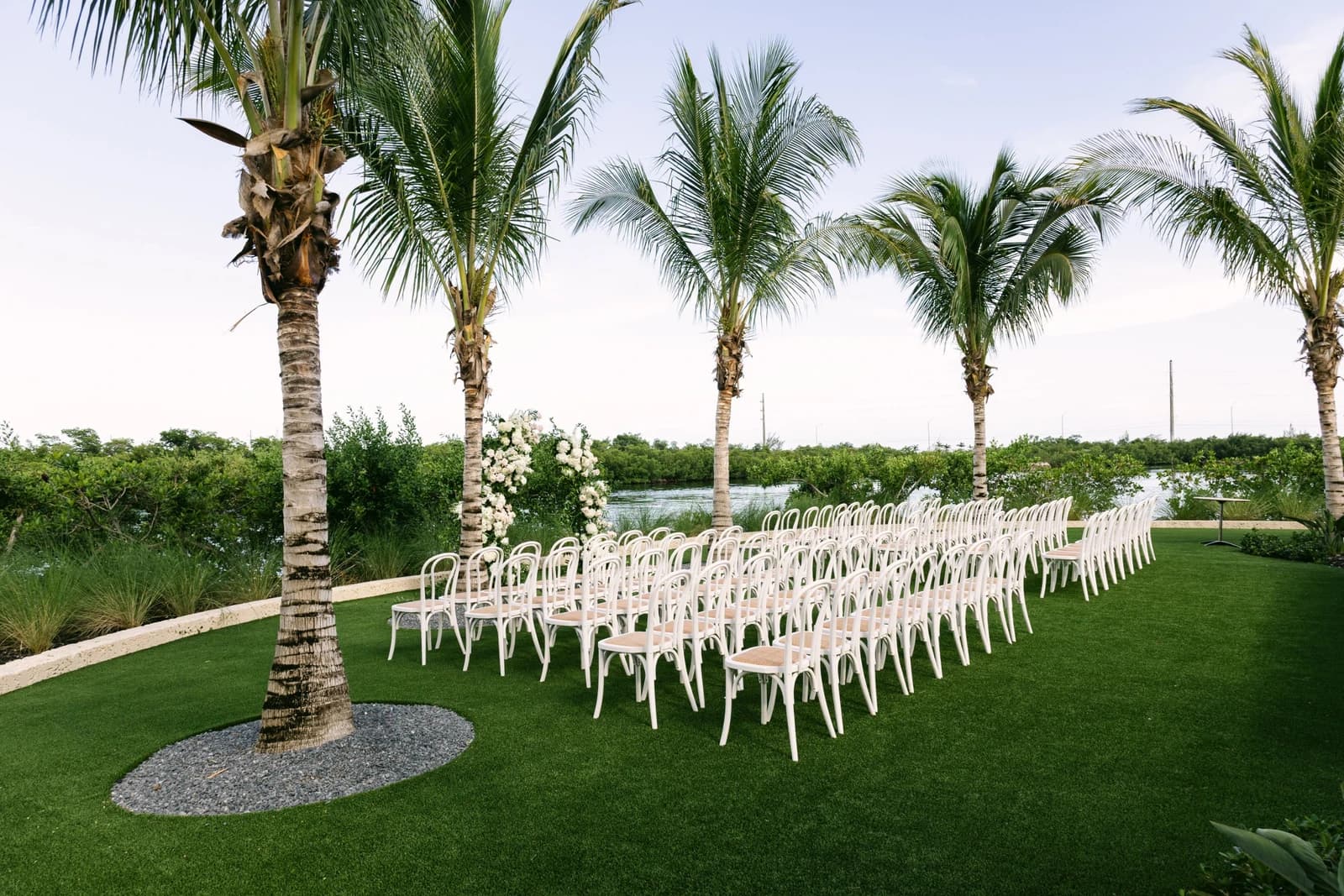
Outdoor ceremonies are beautiful in theory. In practice, they're a lighting puzzle that most couples don't solve until it's too late.
The biggest mistake I see: ceremony sites that face south or west in the afternoon. Your officiant is lit beautifully. Your guests are comfortable. But you and your partner? You're staring directly into the sun. Every vow photo shows you squinting. Every kiss photo has harsh shadows cutting across your face. I've seen this happen at otherwise stunning venues and it breaks my heart every time.
What I look for in an outdoor ceremony site is a north-facing orientation or, at minimum, tall tree coverage that filters direct sunlight. Dappled light through trees is one of the most gorgeous things I can work with, it creates natural texture and warmth without harsh shadows.
The Rivercrossed Alpine Estate near Sundance, Utah is a perfect example of how outdoor spaces can work photographically. Five acres of alpine forest along the Provo River, with natural tree canopy that filters the mountain light. Ceremonies there photograph with this soft, dimensional quality that's almost impossible to replicate with equipment. The forest does the diffusing. The river adds reflective fill light. The mountains provide the backdrop that no studio could build.
Here's another thing to consider: the 2026 trend toward Blue Hour photography is changing when couples schedule their ceremonies. Blue Hour, that 20-minute window right after sunset when the sky turns deep indigo, produces some of the most dramatic, romantic light I've ever worked with. But it requires a ceremony timeline that ends before sunset, and a venue with an outdoor space that faces west or northwest to catch that sky. If your outdoor site is surrounded by tall trees or buildings that block the horizon, you'll miss Blue Hour entirely.
On your venue tour, pull up a sun position app on your phone. Check where the sun will be at your ceremony time. Then physically stand where you'd exchange vows and look at the light on your partner's face. That ten seconds of observation will tell you everything.
The In-Between Spaces That Secretly Make Your Gallery
Here's what actually happens at weddings: about 40% of your best photos aren't taken during the ceremony or reception. They happen in between. Walking down a hallway. Pausing at a window. Turning a corner and catching golden light. The moment right before you walk through the door.
I always tell my couples that transition spaces are some of the most important real estate in a venue. A gorgeous staircase gives me a dramatic bridal portrait. A long hallway with natural light creates a beautiful processional moment. A covered porch or loggia provides shelter during rain while still looking incredible in photos.
The worst venues for photography are the ones where you walk from the ceremony to the reception through a parking lot, a kitchen corridor, or a blank hallway with industrial carpet. Those transitions kill the visual narrative of the day.
The best venues create visual flow. You can trace the wedding day through spaces that each have their own character, the getting-ready suite has warmth and intimacy, the ceremony space has grandeur, the cocktail hour area has texture and natural light, and the reception room has drama. When I deliver a gallery from a venue like that, the photos tell a story just through the changing environments.
Something I've noticed after 200+ weddings: couples who planned their timeline carefully and chose a venue with interesting architecture between the main event spaces ended up with galleries that felt like editorial features. Not because the photography was dramatically different, but because the spaces gave every moment a distinct visual identity.
A Photographer's Venue Tour Checklist
I put together this list for my own couples, and now I'm sharing it with you. Bring this to every venue tour and you'll see spaces the way I do.
Light Check:
- Where are the largest windows? What direction do they face?
- Visit at your ceremony time, how does the light actually look?
- Are there blackout curtains or light-blocking features that limit natural light?
- Do outdoor spaces have partial shade or tree coverage for filtered light?
Background Check:
- Stand in the reception space and count distinct backdrops (aim for 4+)
- Look for texture: stone, wood, brick, plaster, anything with visual interest
- Check for architectural frames: archways, doorways, window frames
- Watch for visual clutter: exit signs, electrical panels, storage visible from main spaces
Ceiling Check:
- How high are the ceilings in the main reception space? (10+ feet is ideal)
- Are there beams, trusses, or architectural details overhead?
- What's the ceiling material? Wood and plaster bounce flash beautifully. Drop ceiling tiles do not.
Outdoor Check:
- What direction does the ceremony site face? (North or northeast is ideal for afternoon)
- Where will the sun be at your ceremony time? Use a sun tracking app.
- Is there tree coverage for natural light diffusion?
- Does the site have a clear western horizon for golden hour and Blue Hour portraits?
Transition Check:
- What do the hallways and paths between spaces look like?
- Is there a photogenic staircase, covered walkway, or window nook?
- Can you get from the ceremony to the reception without crossing a parking lot?
Getting Ready Check:
- Is there a window with natural light in the bridal suite?
- Is there enough space for the photographer to move around without bumping into furniture?
- Does the room have visual character not just a standard hotel room?
Print this out. Literally hand it to your photographer and ask them to do a walkthrough with you. Most photographers will jump at the chance, because they know exactly how much the venue matters.
The Venue Sets the Tone for Every Image
After all these years behind my camera, I've come to believe something that sounds simple but changes how I approach every wedding: a great venue is a collaborator. It works with me. It catches light where I need it, provides depth where I want it, and creates atmosphere that no filter or preset can manufacture.
You don't need the most expensive venue. You don't need the trendiest venue. You need a venue that has good bones, natural light, interesting architecture, ceiling height, visual depth, and spaces that transition beautifully. Some of the best wedding photos I've ever taken were at properties that cost a fraction of the grand ballrooms in the same region. They just happened to have incredible light and character.
The couples who bring their photographer to the venue tour are the ones who end up with galleries that make people ask, "Where was that?" That question means the space and the photos worked together. And that, after 200+ weddings, is still the thing that makes me love this job.
Your venue is the canvas. Your photographer paints on it. Choose a canvas with texture, light, and depth, and the painting practically creates itself.
Ready to Find Your Dream Venue?
I know how overwhelming venue hunting can be (trust me, I've been there!). That's why I created this free tool to cut through the confusion:
Try Our Free Wedding Venue Cost Calculator
- Wedding Venue Cost Calculator
- No email required - get instant results!
Happy planning! 💕
Sources
1. Real Weddings, Real Wedding Photos · brides.com
2. 45 Questions to Ask a Wedding Venue During Your Tour · theknot.com
3. Wedding Inspiration from Real Weddings in Vogue · theknot.com
4. The Etiquette of Wedding Rehearsal Dinners · marthastewart.com